Read the passage
Acts 16:16–40
Read the passage within its full chapter, not as an isolated line.
Read the chapter · World English BibleThe girl's owners profit from her fortune-telling. When that income disappears, they accuse Paul and Silas before the authorities, shifting an economic grievance into a public-order case. The missionaries are beaten and imprisoned without a fair hearing. Their midnight prayer is followed by an earthquake, but the story does not end with escape: Paul intervenes to prevent the jailer's death. The jailer then washes their wounds, receives instruction with his household and offers food. On the following day, Paul challenges the magistrates' attempt to dismiss them quietly after the unlawful beating of Roman citizens. The account brings together spiritual trust, bodily care and insistence on legal responsibility. It should not be reduced to a promise that prayer will unlock every prison. Nor should the enslaved girl disappear from our reading merely because the narrative turns toward the jailer. Ask whose suffering is visible, whose livelihood depends on exploitation, and why reconciliation need not erase accountability.
What we know — and what remains open
Identification of the place
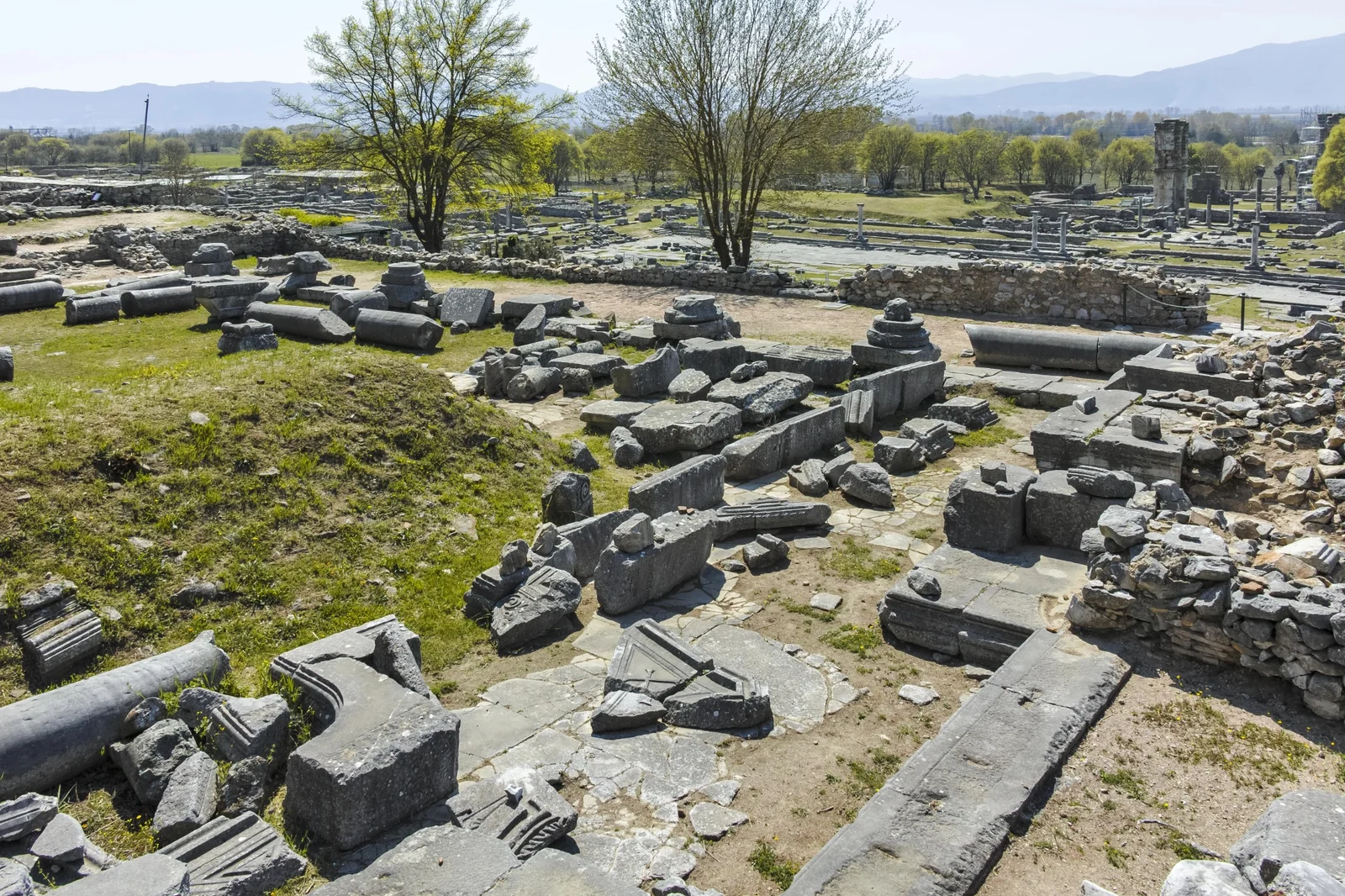
Ancient city identifiedUNESCO's account of Philippi identifies a substantial ancient city with Hellenistic, Roman and Christian layers. The forum and urban remains provide the civic background for Acts. Later basilicas show the development of Christian life, but neither those churches nor the visible city fabric independently authenticates a particular first-century prisoner.
Connection to the event
Prison attribution is traditionalPilgrimage routes include a traditional prison associated with Paul and Silas. Its value is commemorative: it concentrates a community's memory of the biblical story. Introduce it with that qualification before entering or photographing, rather than allowing the name on a route to become a claim of demonstrated occupancy.
What this does not establish
Archaeology can illuminate Roman civic life without verifying the earthquake, the dialogue or the identity of a cell's occupants. The passage does not teach that prisoners who remain confined lack faith. Its concern for a threatened life should also be read as care, not romanticization of despair.
Questions to explore
- Read the accusation near the forum area, then compare the language of public order with the financial motive described earlier in the chapter.
- Visit the traditional prison only as the site's current route permits; afterward look at the later basilicas as evidence of memory developing over centuries.
Plan with the place in mind
- Plan the archaeological site and Lydia's nearby sanctuary as separate stops, allowing time to connect the household scenes at both ends of the chapter.
- Ask site staff about gradients, steps and accessible alternatives before taking a group toward any confined commemorative space.
- Carry drinking water and read in a designated resting area; do not climb ancient walls to reconstruct a dramatic scene for photographs.
Opening hours and prices are not live. Before traveling, confirm access, services and local conditions with the site operator and relevant authorities.
No precise location
No verified cell coordinate is asserted. The archaeological city provides context; the prison attribution remains traditional.
Take something with you
Consider a situation where making peace has been confused with staying silent. What truthful, proportionate request for accountability could accompany genuine care for everyone involved?
Continue in prayer · For ThisSources & further reading
Sources explain the passage, the tradition or the present site; they do not all support the same kind of claim.
Guide prepared: November 12, 2026. AI-assisted synthesis; no independent academic review. Our editorial approach