Read the passage
Matthew 21:12–17
Read the passage within its full chapter, not as an isolated line.
Read the chapter · World English BibleJesus has entered Jerusalem and now acts within its central place of worship. His scriptural language brings together a house of prayer and a den of robbers, drawing readers toward Isaiah and Jeremiah rather than toward a modern argument about church gift shops. Jeremiah’s Temple critique challenges the assumption that sacred association protects people who act unjustly; it is not simply a complaint about retail prices. Matthew then shows blind and lame people approaching Jesus and children praising him. The chief priests and scribes object, and Jesus answers with another scriptural reference. This is a dispute within the Jewish religious world in which Jesus, his followers, and the prophets belong. It must not become a caricature of a corrupt Jewish religion replaced by a supposedly untainted outside faith. The interpretive question is concrete: whom does a sacred institution welcome, and what conduct does it excuse? The episode confronts the gap between a declared purpose and an institution’s actual life.
What we know — and what remains open
Identification of the place
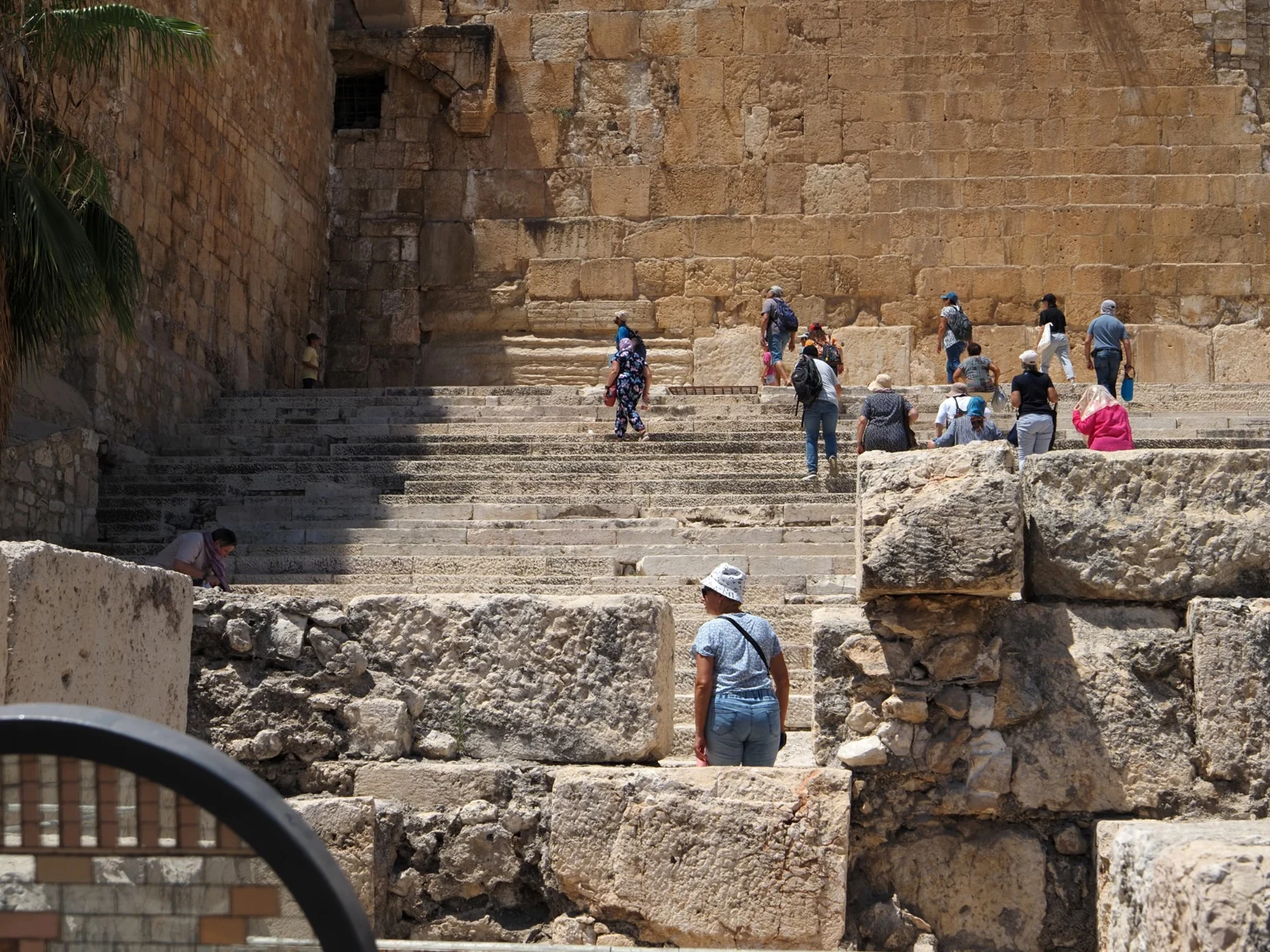
Temple setting identified; exact court unknownThe Temple’s broad location is known. Archaeological remains near the southern enclosure help explain approaches, movement, and the scale of the complex. The Davidson Centre interprets this setting from outside the present elevated compound; its entrance is not an entrance to that compound.
Connection to the event
Southern approaches provide contextChristian visitors connect the Southern Steps with Gospel accounts of Temple visits. They are a valuable orientation point for an ancient pilgrimage environment, but no surviving table position or marked paving stone identifies Matthew’s confrontation. Modern reconstructions help visualize a lost building and should be recognized as reconstructions.
What this does not establish
The exact court and movements in this episode cannot be reconstructed from the visitor route. Temple Mount/Haram al-Sharif is a living sacred compound with separate arrangements. Do not infer permission to enter religious spaces from possession of an archaeological-park ticket, or treat current worshippers as actors in the Gospel dispute.
Questions to explore
- Study the scale of the southern approaches before imagining a single small courtyard.
- Compare the archaeological displays with a clearly labelled reconstruction, separating surviving material from what has been digitally restored.
Plan with the place in mind
- Plan the Davidson Centre as its own visit and ask its operator about the current route and step-free alternatives.
- Any visit to the elevated compound requires separate confirmation of current entry rules, permitted routes, clothing, and conduct.
- Read verses 14–17 after the familiar table episode: the healing and the children should not disappear from a group’s interpretation.
Opening hours and prices are not live. Before traveling, confirm access, services and local conditions with the site operator and relevant authorities.
No precise location
This story concerns the Temple precinct; the exact confrontation point is unknown.
Take something with you
Consider one community you belong to. What small change would make its stated welcome more real for someone who is usually overlooked? Begin with listening to that person rather than announcing a reform on their behalf.
Continue in prayer · For ThisSources & further reading
Sources explain the passage, the tradition or the present site; they do not all support the same kind of claim.
- Matthew 21:12–17 · full biblical text
- Israel Antiquities Authority · Davidson Centre
- Israel Ministry of Tourism · Davidson Centre
- World English Bible · Full chapter
Guide prepared: November 12, 2026. AI-assisted synthesis; no independent academic review. Our editorial approach