Read the passage
Luke 2:22–38
Read the passage within its full chapter, not as an isolated line.
Read the chapter · World English BibleMary and Joseph bring Jesus to Jerusalem and make the offering described by Luke with reference to the law of Moses. The narrative repeatedly stresses faithful observance, so it should not be read as a rejection of Jewish practice. Simeon, waiting for Israel’s consolation, receives the child and praises God. His words join light for the nations with glory for Israel, rather than making those hopes enemies. Yet the blessing is followed by difficult speech to Mary: this child will provoke division, and suffering will pierce her own life. Anna then appears as a prophetess whose long life of worship leads to thanksgiving and testimony to those awaiting Jerusalem’s redemption. Neither age nor widowhood makes her peripheral to the scene. Read the two witnesses together. Hope here has patience, public speech, and a cost; it is not a guarantee that family life will become easy. The question is whether a community recognizes the insight of people whose age or circumstances cause others to overlook them.
What we know — and what remains open
Identification of the place
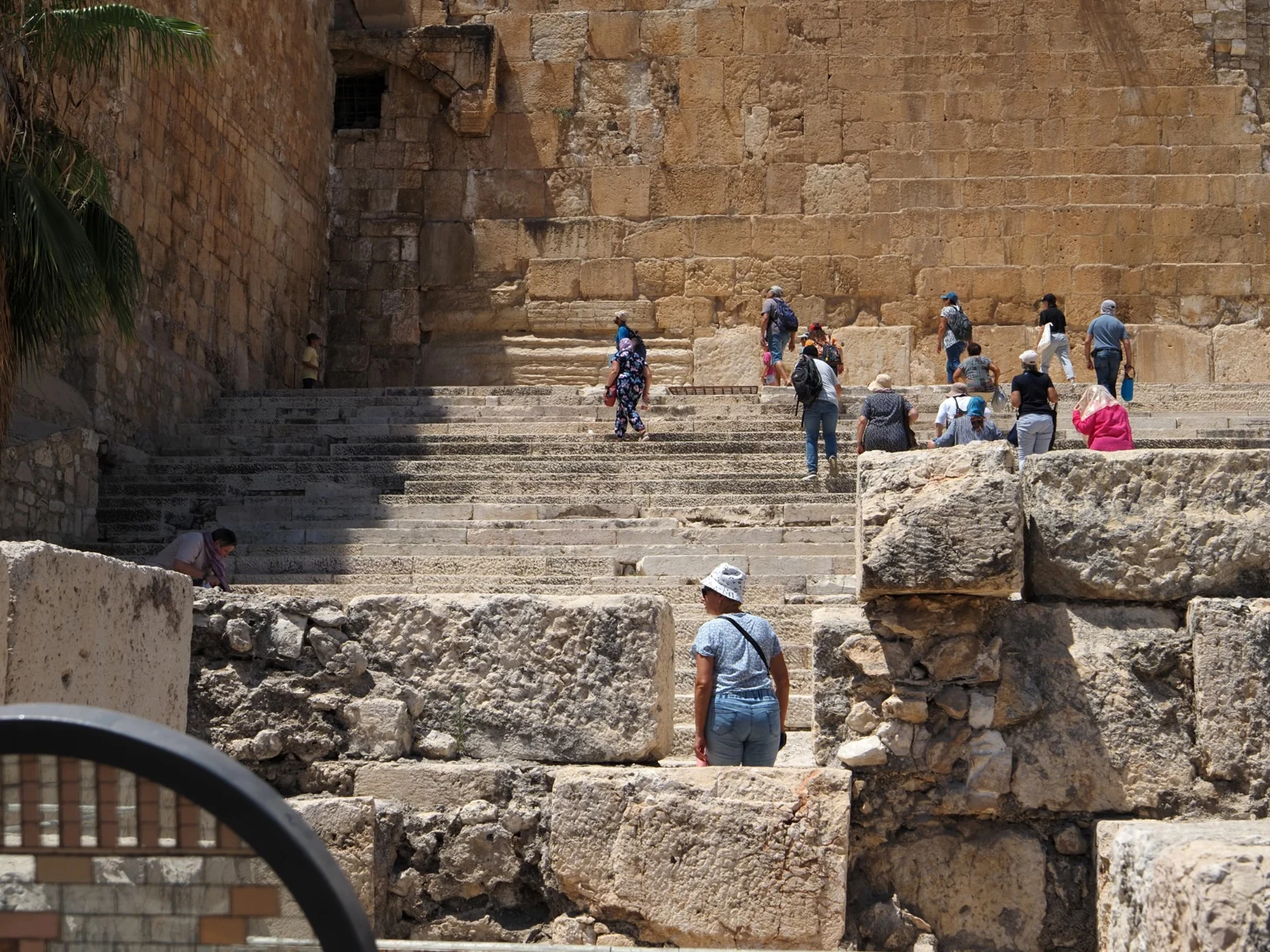
Temple setting identifiedThe Temple’s general location is established, while its building and inner courts no longer survive as Luke describes them. Archaeological interpretation at the Davidson Centre and the southern approaches can explain the larger pilgrimage setting. It does not identify where Simeon held the child or Anna spoke.
Connection to the event
Meeting point unknownChristians remember this episode in the feast of the Presentation and in prayers shaped by Simeon’s song. Reading it near the former Temple is a contextual practice. The surviving approaches should not be relabelled as the exact Presentation steps unless evidence supports a more specific claim.
What this does not establish
Luke does not provide a floor plan or a marked meeting point. The archaeological park is separate from Temple Mount/Haram al-Sharif, whose present religious life deserves respect. An account of ancient Jewish worship should not become a pretext for disregarding current worship or entry arrangements.
Questions to explore
- Use the southern approaches to think about a family entering a large pilgrimage environment rather than an isolated private chapel.
- Read Anna’s verses in full; her active thanksgiving and speech balance a reading focused only on Simeon.
Plan with the place in mind
- Check the archaeological centre’s current route, surfaces, and available assistance before a visit with older travellers.
- Do not assume a park visit includes the elevated compound; any separate visit requires current confirmation of its own rules.
- Allow a seated reading if possible. A passage honouring older witnesses is poorly served by an itinerary that gives older visitors no time to rest.
Opening hours and prices are not live. Before traveling, confirm access, services and local conditions with the site operator and relevant authorities.
No precise location
The Temple setting is known, but the meeting has no verified precise location.
Take something with you
Ask an older person what they have learned to wait for and what they hope younger people will notice. Listen without turning their answer into a lesson you have already decided to teach.
Continue in prayer · For ThisSources & further reading
Sources explain the passage, the tradition or the present site; they do not all support the same kind of claim.
- Luke 2:22–38 · full biblical text
- Israel Antiquities Authority · Davidson Centre
- Israel Ministry of Tourism · Davidson Centre
- World English Bible · Full chapter
Guide prepared: November 12, 2026. AI-assisted synthesis; no independent academic review. Our editorial approach