Read the passage
Matthew 26:57–68
Read the passage within its full chapter, not as an isolated line.
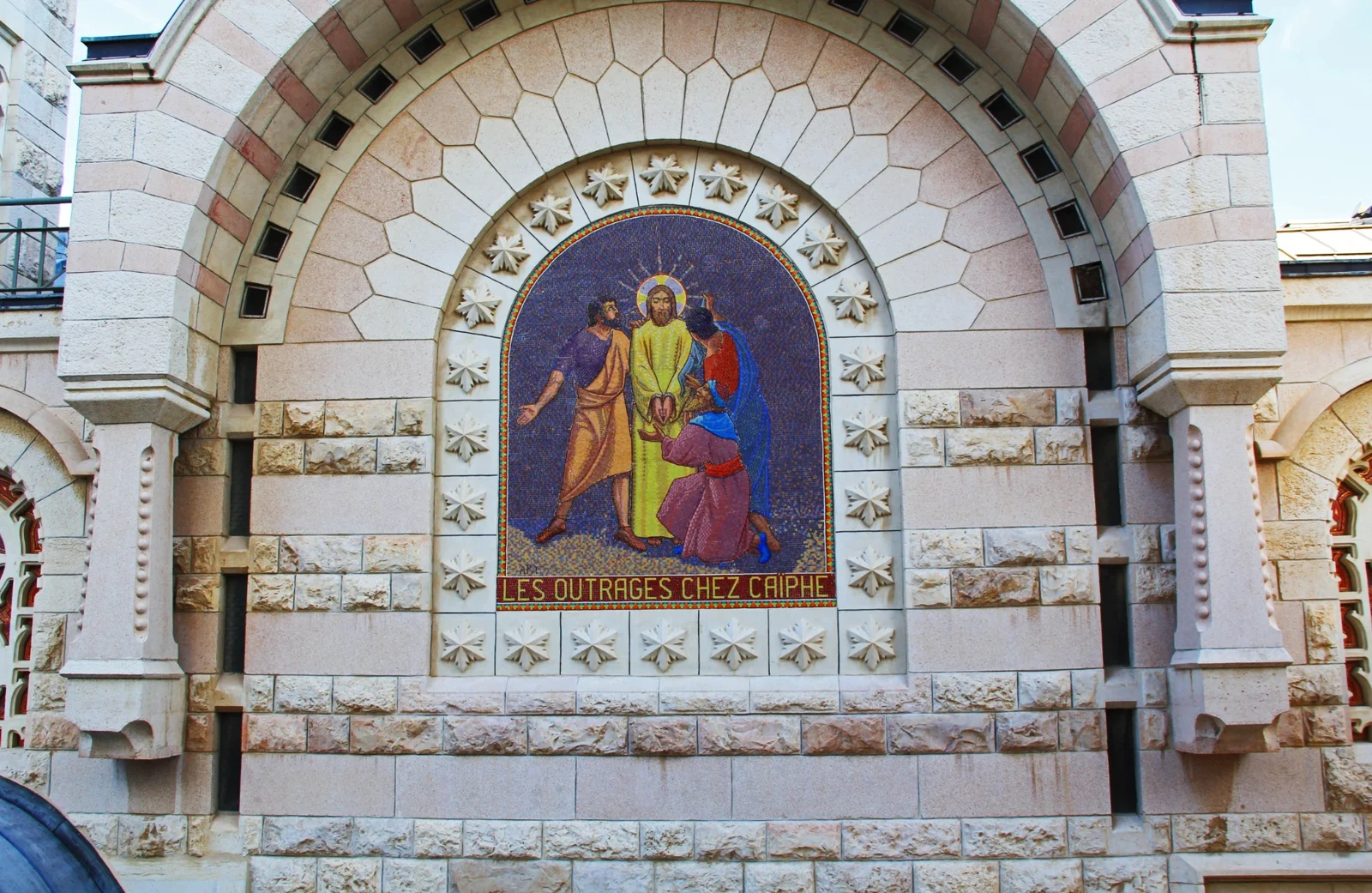
Read the chapter · World English BibleMatthew follows the arrest with a hearing at the high priest’s house. Peter follows at a distance and sits in the courtyard, preparing the adjacent story of his denial. Inside, testimony is sought against Jesus, and the accusation about destroying and rebuilding the Temple becomes part of the exchange. Jesus initially remains silent. When the high priest puts the question of Messiah and Son of God to him, his answer invokes the Son of Man and coming authority. The leaders judge the response as blasphemy, and the scene descends into humiliation and violence. Read the difference between the narrator’s description of testimony and the claims made by the speakers. A witness’s words inside a story are not automatically the author’s endorsement of their accuracy. The pairing of the hearing and Peter’s courtyard experience also prevents readers from looking only at the failure of outsiders. A disciple’s loyalty is under pressure nearby. This is not a script for assigning guilt to an entire people: Jesus, Peter, and the actors in the hearing belong to the Jewish world of the narrative. The later Roman proceedings must also retain their own agency and responsibility.
What we know — and what remains open
Identification of the place
What can be locatedGallicantu stands on the eastern slope of Mount Zion and includes excavated ancient structures beneath and around a later church. These remains establish an archaeological setting. They do not independently identify the owner as Caiaphas or verify the exact hearing room.
Connection to the event
How the place is rememberedThe sanctuary connects the hearing, Peter’s denial, and remembered imprisonment. Its own wider custodial literature recognizes competing traditions for the high priest’s house. A cave or chamber presented for devotion should therefore be described as a commemorative association, not a proven cell used by Jesus.
What this does not establish
Archaeology cannot authenticate each spoken exchange or identify a particular prisoner from the presence of a chamber. Do not claim that adjacent ancient steps are demonstrably the exact steps Jesus used that night. The site’s disputed identification should remain visible throughout the visit.
Questions to explore
- Compare the church’s images with the excavated structures. Ask which features belong to artistic interpretation, which to ancient architecture, and which to a proposed identification of the owner.
- Read the hearing alongside Peter’s courtyard narrative. The movement between public accusation and private fear gives the sanctuary’s linked memories greater depth.
Plan with the place in mind
- Use the sanctuary’s current visitor instructions and ask about steps, underground spaces, and alternative routes before bringing anyone with mobility or enclosed-space concerns.
- Allow enough time to read the archaeological labels rather than moving directly from one dramatic chamber to another. Ask guides to state the degree of certainty behind each claim.
- Keep prayer and discussion considerate of other visitors. A place associated with humiliation is especially unsuitable for theatrical mock trials or photographing strangers as participants.
Opening hours and prices are not live. Before traveling, confirm access, services and local conditions with the site operator and relevant authorities.
No precise location
The sanctuary is locatable, but its identification with Caiaphas’s house and the precise hearing space is disputed; no exact event pin is asserted.
Take something with you
Think about a claim against someone that you have accepted without checking. Separate what you know, what someone alleged, and what remains uncertain. Integrity may begin by refusing to repeat an accusation as established fact.
Continue in prayer · For ThisSources & further reading
Sources explain the passage, the tradition or the present site; they do not all support the same kind of claim.
- Matthew 26:57–68 · full biblical text
- Archaeological site — Saint Peter in Gallicantu
- The Shrine of Saint Peter in Gallicantu — Assumptionists
Guide prepared: November 12, 2026. AI-assisted synthesis; no independent academic review. Our editorial approach