Read the passage
Matthew 14:22–33
Read the passage within its full chapter, not as an isolated line.
Read the chapter · World English BibleRead from the departure rather than starting with Peter’s dramatic step. Jesus sends the disciples ahead and dismisses the crowd, then withdraws alone. The boat meets contrary wind. When Jesus approaches, the disciples first interpret his presence as a frightening apparition. His reassurance precedes Peter’s request. Peter does not invent an independent challenge: he asks Jesus to command him to come. Once he becomes afraid and sinks, the response is an outstretched hand. The story concludes inside the boat, with worship, not with Peter celebrated as a successful spiritual athlete. Matthew holds courage, uncertainty, dependence, and rescue together. Its distinctive question is therefore not how to achieve an extraordinary feat, but how recognition grows when a person’s confidence proves incomplete. The surrounding scenes also matter: the same Jesus who provides bread meets the disciples when provision does not look like abundance but like help in danger. Neither episode becomes a guarantee of spectacular experiences on demand.
What we know — and what remains open
Identification of the place
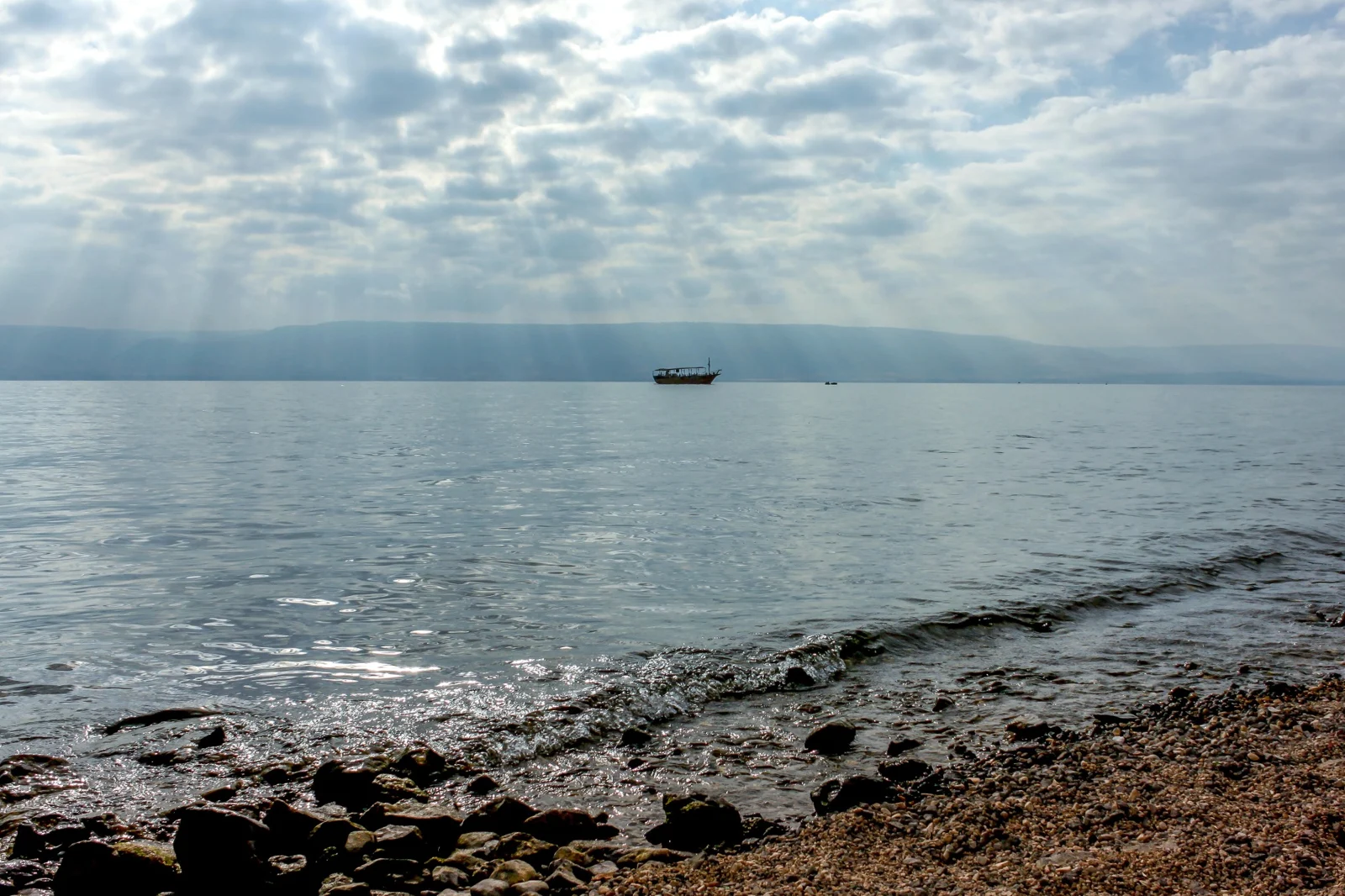
Lake identified; no exact event pointThe lake and the Gennesaret area named after the crossing can be visited. No exact position for the encounter has been established. A shoreline stop at Tabgha is a practical reading setting; it does not identify where Peter left the boat or where Jesus approached it.
Connection to the event
Nearby lake commemorationsThe Christian sanctuaries around Tabgha preserve several distinct Gospel memories. Their proximity encourages reading related lake passages together, provided the calling, feeding, night crossing, and resurrection breakfast remain separate episodes. The museum boat at Ginosar can supply material context, never evidence for walking on water.
What this does not establish
The passage is not an invitation to test faith by entering dangerous water. Nor does sinking justify blaming someone for illness, grief, or an unsuccessful decision. Matthew narrates a particular encounter with Jesus; it cannot be converted into a universal law that confidence controls physical outcomes.
Questions to explore
- Compare the open lake with the sheltered spaces of the shore, noticing how distance changes a person’s sense of control.
- If visiting Tabgha’s Primacy chapel, read John 21 separately and compare the later conversation with Peter rather than treating the church as the walking-on-water site.
Plan with the place in mind
- Choose a safe public viewing point or an authorized sanctuary area; shoreline access is not uniform around the lake.
- For an optional sailing trip, follow the captain’s instructions and current weather decisions. No recreation of Peter’s action is appropriate.
- Allow a quiet reading after the visit instead of trying to discuss a long passage over a boat engine or a busy boarding area.
Opening hours and prices are not live. Before traveling, confirm access, services and local conditions with the site operator and relevant authorities.
No precise location
No precise location for this encounter is known; shoreline stops provide context only.
Take something with you
Where would asking for help be a more truthful next step than trying to appear fearless? Name one person you can contact, remembering that receiving an offered hand is part of this story’s movement toward trust.
Continue in prayer · For ThisSources & further reading
Sources explain the passage, the tradition or the present site; they do not all support the same kind of claim.
- Matthew 14:22–33 · full biblical text
- Custody of the Holy Land · Tabgha sanctuary
- Yigal Allon Centre · Ancient boat
- World English Bible · Full chapter
Guide prepared: November 12, 2026. AI-assisted synthesis; no independent academic review. Our editorial approach