Read the passage
Mark 4:35–41
Read the passage within its full chapter, not as an isolated line.
Read the chapter · World English BibleThe disciples follow Jesus’ instruction to cross; the danger does not arise because they chose to ignore him. Waves enter the boat while he sleeps in the stern. Their appeal is not a polished confession but a frightened accusation that he does not care. Jesus addresses the wind and water, then asks about their fear and faith. The narrative’s last response is another kind of fear: the disciples wonder who can command the elements. That movement from threatened survival to bewilderment is essential. Reading the story only as a technique for personal calm misses its central question. It also risks blaming anxious people for symptoms they cannot simply switch off. Mark does not promise that every faithful person will survive every accident, nor that prayer replaces seamanship. The chapter’s teaching about hearing is now tested in a situation where listeners cannot control what happens. The boat holds people who are already following, yet still have much to learn.
What we know — and what remains open
Identification of the place
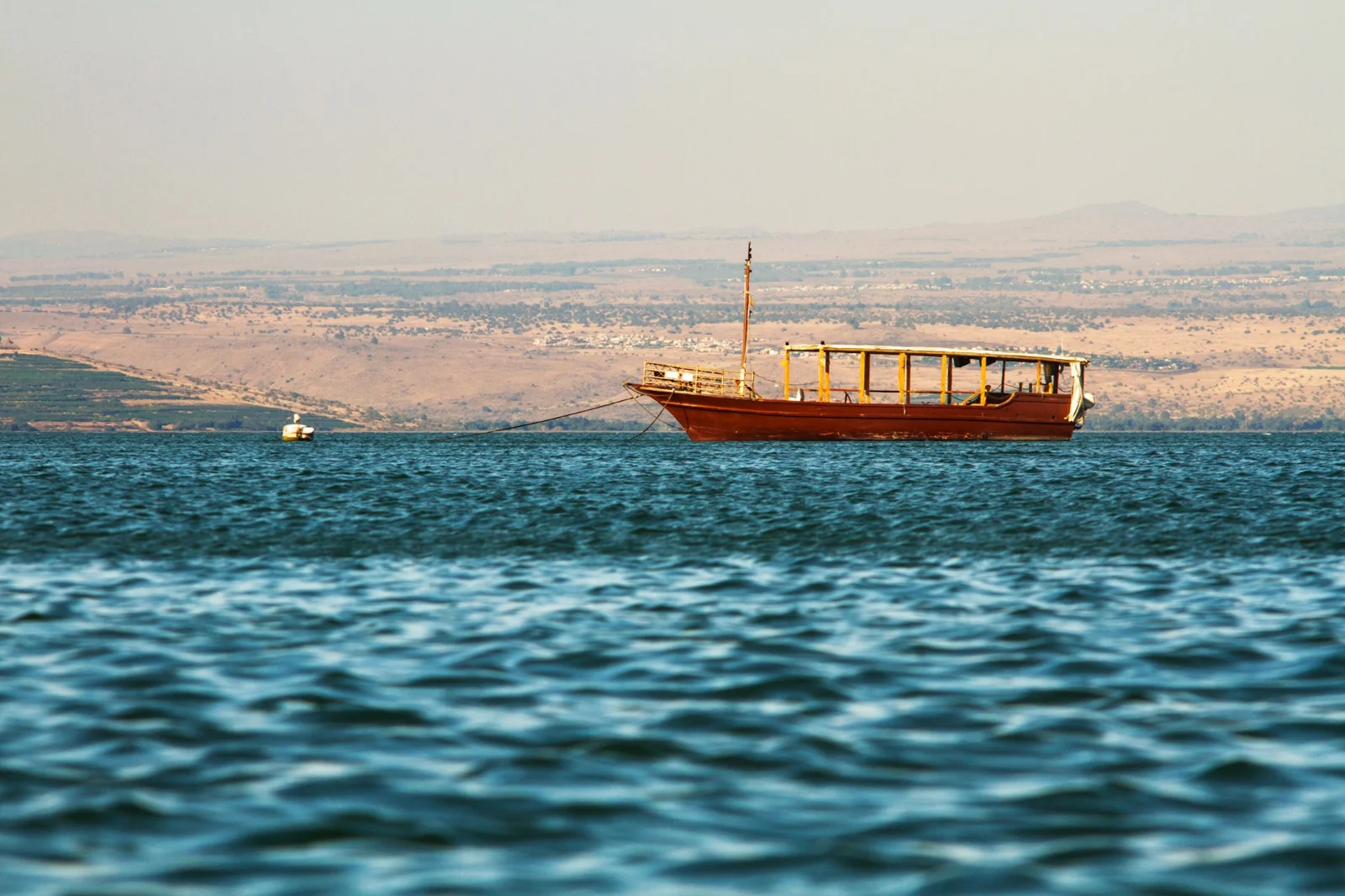
Lake identified; event location unknownThe Sea of Galilee is the narrative’s geographical setting. The ancient boat displayed at Ginosar was found in 1986 and dates broadly around the first century. It illustrates the scale and vulnerability of wooden lake craft, not the specific boat described by Mark.
Connection to the event
Devotional lake crossingPilgrims often read this passage during a lake crossing. That practice is a contemporary devotional experience, not a preserved sailing route from the Gospel. The museum’s conservation story is valuable in its own right and should remain distinct from claims about who once occupied the vessel.
What this does not establish
Mark supplies no launch coordinates, weather measurements, or surviving eyewitness chart. Present-day wind cannot authenticate a past miracle. A frightening crossing should never be arranged as an imitation of the passage, and distress should not be treated as evidence that someone lacks sincere faith.
Questions to explore
- Observe the preserved hull and imagine water entering a working vessel whose occupants cannot escape onto a broad deck.
- Read the final question beside the lake, leaving a pause before supplying a familiar doctrinal answer.
Plan with the place in mind
- The museum is a land-based alternative for visitors who cannot or prefer not to sail. Check current access directly with the Yigal Allon Centre.
- If choosing a boat trip, use an operator following current safety rules, accept weather cancellations, and wear the required flotation equipment.
- Build shade, drinking water, and an unhurried discussion into a shoreline visit; a crowded jetty is a poor place for a group to stop and read.
Opening hours and prices are not live. Before traveling, confirm access, services and local conditions with the site operator and relevant authorities.
No precise location
The Gospel does not locate the storm precisely; no event pin is shown.
Take something with you
When fear makes you assume that nobody cares, what honest request for help could you make today? The disciples’ rough-edged appeal leaves room for prayer that begins before composure returns.
Continue in prayer · For ThisSources & further reading
Sources explain the passage, the tradition or the present site; they do not all support the same kind of claim.
- Mark 4:35–41 · full biblical text
- Yigal Allon Centre · Ancient boat gallery
- World English Bible · Full chapter
Guide prepared: November 12, 2026. AI-assisted synthesis; no independent academic review. Our editorial approach