Read the passage
Matthew 27:32–56
Read the passage within its full chapter, not as an isolated line.
Read the chapter · World English BibleSimon is compelled to carry the cross, Jesus reaches Golgotha, soldiers divide his clothing, and the charge above him names kingship. Mockery repeatedly demands that he save himself. That demand echoes earlier tests of identity, but the scene does not resolve through a spectacular escape. Matthew records darkness, Jesus’ cry using the language of Psalm 22, misunderstanding among bystanders, and his death. The narrative then describes the torn Temple curtain and extraordinary signs, the centurion’s response, and women watching from a distance. Those women have followed and served from Galilee; their presence is part of the account, not an incidental detail. The theological meaning of the signs should be read as the Gospel presents it, not marketed as something a visitor can verify by looking at a crack in stone. Crucifixion was carried out under Roman authority. The Passion must never be used to assign inherited or collective guilt to Jewish people. Jesus’ anguish belongs within Jewish prayer and Scripture, not outside them.
What we know — and what remains open
Identification of the place
Ancient landscape; established sanctuaryThe Holy Sepulchre contains the traditional Calvary and tomb commemorations. Remains of an ancient quarry survive within the complex, providing material context for the landscape before the church. Such evidence concerns the character and development of the site; it cannot independently authenticate every narrated event.
Connection to the event
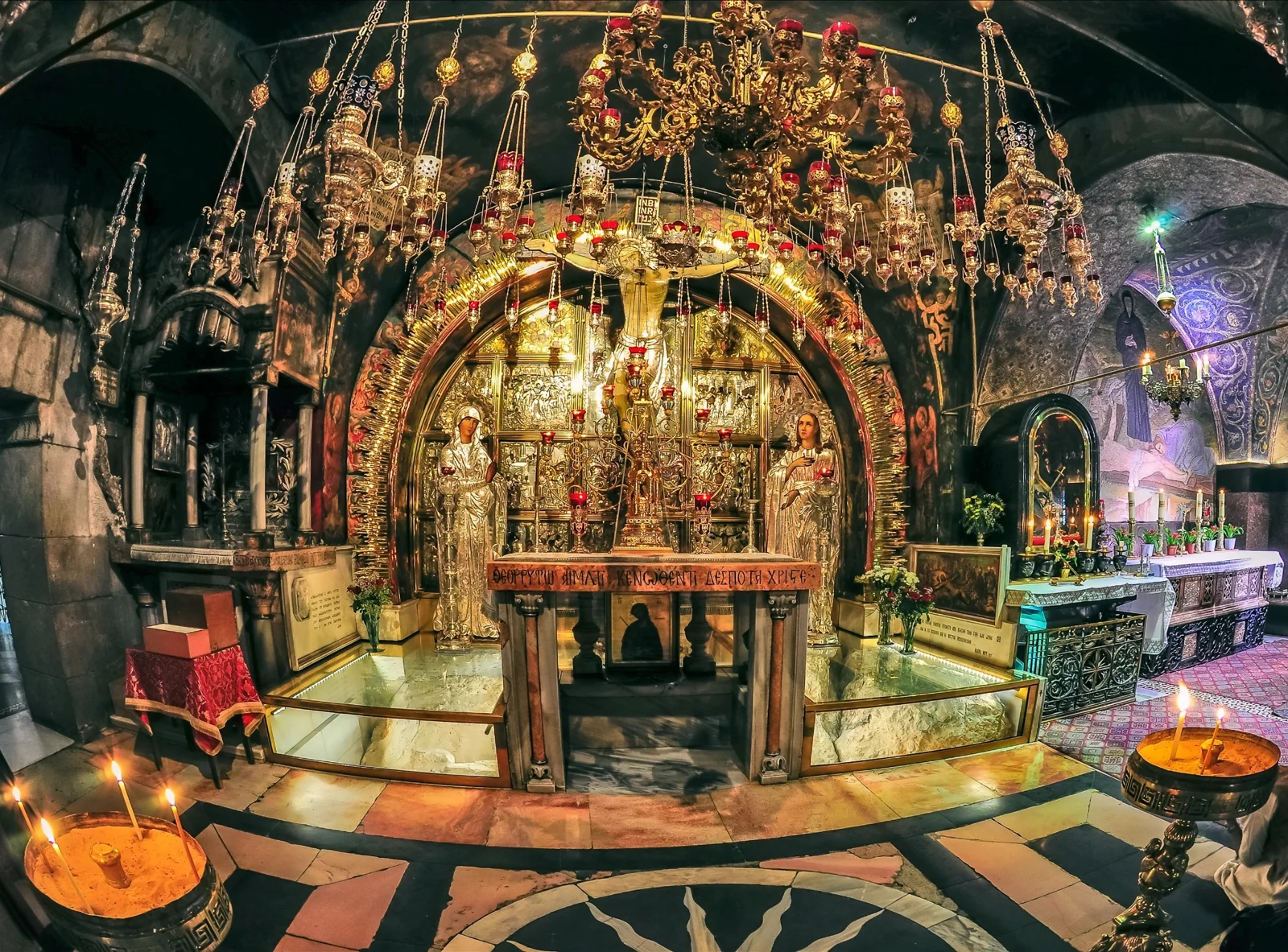
Longstanding Calvary identificationThe Calvary chapel expresses a long Christian tradition that places the crucifixion here. Its altars, icons, lamps, and patterns of prayer show how communities have approached the same memory over time. The present interior should not be mistaken for the appearance of Golgotha in the first century.
What this does not establish
Archaeological context and sustained tradition are different kinds of support. Neither can demonstrate the supernatural signs of Matthew’s account. A crack or rock surface should not be introduced as a scientifically verified trace of the earthquake or the precise socket of the cross without evidence that establishes that claim.
What to notice when you visit
- Notice the transition from the church entrance to the elevated Calvary chapels, then distinguish their present arrangement from an open-air execution landscape.
- Read the verses about the women as attentively as the more familiar words spoken at the cross.
Plan with the place in mind
- Calvary is reached by stairs; ask in advance about what can be meaningfully visited if climbing is not possible.
- The church is shared and active. Follow local directions about queues, photography, and services rather than assuming unrestricted access to each altar.
- Allow time to move from Calvary to the tomb without compressing death and resurrection into a rushed photo stop.
Opening hours and prices are not live. Before traveling, confirm access, services and local conditions with the site operator and relevant authorities.
The pin marks the church complex; it is not a measured point for the cross. Open map
Take something with you
What changes when you remain with another person’s suffering without demanding an immediate explanation or happy ending? A quiet act of presence may be a more faithful response than a confident speech.
Continue in prayer · For ThisSources & further reading
Sources explain the passage, the tradition or the present site; they do not all support the same kind of claim.
- Matthew 27:32–56 · full biblical text
- Custody of the Holy Land · Holy Sepulchre
- World English Bible · Full chapter
Guide prepared: November 12, 2026. AI-assisted synthesis; no independent academic review. Our editorial approach