Read the passage
Luke 23:26–32
Read the passage within its full chapter, not as an isolated line.
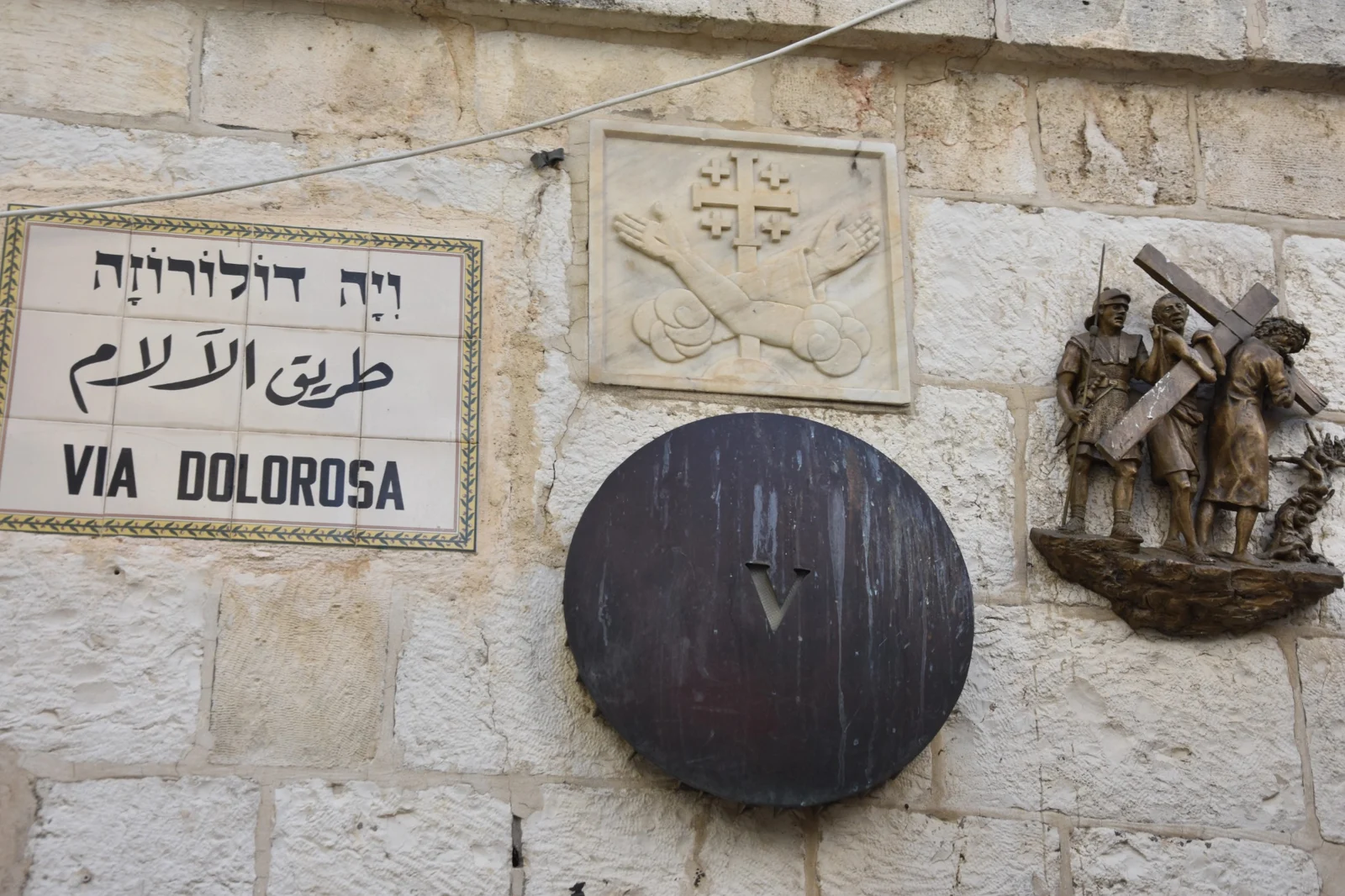
Read the chapter · World English BibleLuke’s short account places Simon of Cyrene behind Jesus, carrying the cross after being compelled to do so. A large gathering follows, including women who lament. Jesus addresses the women of Jerusalem with a warning that moves their attention beyond his immediate suffering. Two criminals are also led out for execution. These few verses do not describe every station familiar from a church wall or a pilgrimage booklet. The three falls and Veronica’s veil, for example, belong to devotional tradition rather than to this canonical account. Their themes can still guide meditation when the distinction is made clearly. Simon introduces another unsettling feature: participation begins under compulsion, not as a freely planned heroic gesture. The women’s presence also prevents the route from being imagined only as a procession of officials and soldiers. A careful walk asks who is carrying a burden, who is watching, and whose grief is heard, while avoiding invented descriptions of every turn Jesus took.
What we know — and what remains open
Identification of the place
Present pilgrimage route identifiedThe present route is identifiable in the Old City, and its final five stations are commemorated within the Church of the Holy Sepulchre. Street surfaces, buildings, and route arrangements reflect many centuries of urban change. The devotional route is real; its equivalence to an ancient execution route is not established.
Connection to the event
Developed devotional itineraryFranciscan interpretation presents the stations as a developed practice of accompanying the Passion. The traditional eastern beginning also depends on a Praetorium identification that is debated. Reading each stop with an explicit biblical or devotional label respects both the texts and the later prayer tradition.
What this does not establish
Do not label every stone an original footprint or every station a direct Gospel quotation. The streets are home and workplace to present-day residents of different communities. Their daily activity is not an interruption of an ancient scene that visitors own, and respectful pilgrimage should not obstruct it.
Questions to explore
- Compare a station with its associated reading, noticing when the meditation draws on later tradition rather than a stated verse.
- At the Sepulchre, observe how the route changes from public street to a shared church with several worshipping communities.
Plan with the place in mind
- Use a current route description and ask about changed access before beginning; stations and entrances need not all be available together.
- Steps, slopes, crowds, and uneven paving can make the full walk demanding. Agree on a shorter alternative for anyone who needs one.
- Keep doorways clear, ask before photographing people, and let worship take precedence over group commentary inside the church.
Opening hours and prices are not live. Before traveling, confirm access, services and local conditions with the site operator and relevant authorities.
No precise location
This is a multi-stop route; no single pin represents the historical path to crucifixion.
Take something with you
What burden could you help carry without turning the person receiving help into a symbol for your own spiritual journey? Choose practical service that respects their voice and consent.
Continue in prayer · For ThisSources & further reading
Sources explain the passage, the tradition or the present site; they do not all support the same kind of claim.
- Luke 23:26–32 · full biblical text
- Terra Sancta Museum · Fourteen stations
- World English Bible · Full chapter
Guide prepared: November 12, 2026. AI-assisted synthesis; no independent academic review. Our editorial approach