Read the passage
John 10:22–39
Read the passage within its full chapter, not as an isolated line.
Read the chapter · World English BibleThe question concerns whether Jesus is the Messiah. His answer directs attention to works already done and to the relationship between the shepherd and the sheep, continuing imagery from earlier in the chapter. Hearing, knowing, and following belong together. The promise that the sheep cannot be snatched from his hand is about their relationship to him, not a claim that followers will never suffer physical danger. The conversation intensifies when Jesus speaks of unity with the Father. His opponents take up stones, and he responds through a scriptural argument before again directing attention to his works. John eventually moves the story beyond the Jordan. Keep the whole exchange in view: selecting a reassuring sentence alone loses the dispute about identity that gives it force. The festival’s Jewish setting is essential, not background decoration. This is a controversy within a world shaped by Israel’s Scriptures and worship. How does the chapter ask people to evaluate a claim: by a title alone, by observed works, or by a relationship of listening and following? That question remains more fruitful than trying to reconstruct the exact distance between the speakers.
What we know — and what remains open
Identification of the place
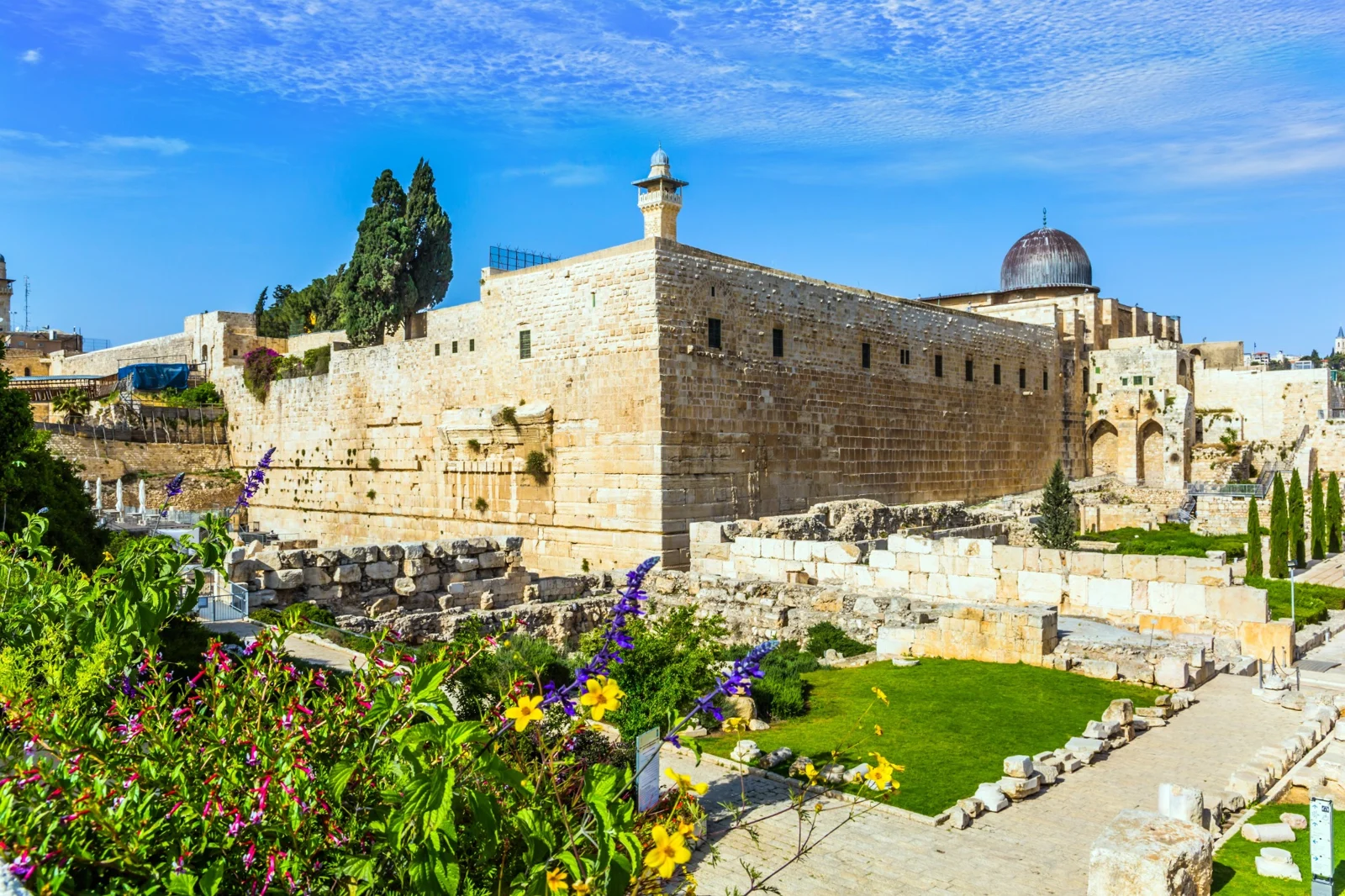
What can be locatedJohn names Solomon’s Portico within the Temple setting. The ancient Temple superstructure is not preserved as a walk-through building. Archaeology around the southern approaches helps explain the scale of the complex but does not supply this portico’s intact floor or roof.
Connection to the event
How the place is rememberedPilgrimage readings often connect several Temple episodes to one Jerusalem visit. That is sensible as a thematic itinerary, provided the guide distinguishes the text’s named spaces from the areas actually accessible today and from later buildings occupying the sacred landscape.
What this does not establish
The portico’s name does not prove that its visible remains survive or that its fabric dated to Solomon. Nor should the opponents in this exchange be generalized into a timeless Jewish rejection. The passage describes a particular disputed encounter, not permission for religious hostility.
Questions to explore
- Begin with a plan of the Temple precinct and its approaches. Locate the narrative conceptually while clearly distinguishing reconstructed information from excavated masonry on display.
- Read the shepherd imagery before verse 22, then the winter encounter. The repeated language makes more sense when its earlier development remains audible.
Plan with the place in mind
- Use the Davidson Center as an optional context stop, confirming access directly. Do not sell or book it as admission to Solomon’s Portico.
- If visiting any part of the living sacred compound, check its specific arrangements and follow custodial instructions. Archaeological tickets do not resolve separate religious-site access requirements.
- For a winter-themed reading, choose shelter appropriate to the actual weather rather than insisting on an outdoor location. John’s season is a literary detail, not a demand on visitors.
Opening hours and prices are not live. Before traveling, confirm access, services and local conditions with the site operator and relevant authorities.
No precise location
No surviving visitor space is identified as the exact portico scene. The Temple landscape is contextual.
Take something with you
Consider a claim you have accepted because it sounds authoritative. Spend ten minutes examining the actions that accompany it. Let careful listening and observable conduct matter alongside impressive language.
Continue in prayer · For ThisSources & further reading
Sources explain the passage, the tradition or the present site; they do not all support the same kind of claim.
Guide prepared: November 12, 2026. AI-assisted synthesis; no independent academic review. Our editorial approach