Read the passage
Luke 1:57–80
Read the passage within its full chapter, not as an isolated line.
Read the chapter · World English BibleElizabeth’s relatives and neighbours share her joy after the birth. At the naming, they expect the child to receive his father’s name. Elizabeth says otherwise, and Zechariah confirms John in writing. His speech returns, but his first recorded use of that renewed voice is blessing, not a speech about the inconvenience of his silence. The Benedictus then expands the family event into a song of covenant, mercy, deliverance, and service without fear. When it addresses the child directly, John’s future is described as preparing the way and giving knowledge of salvation through forgiveness. The song ends with the image of dawn guiding feet into peace. These details resist making John merely an accessory in a Christmas scene. He has a distinct vocation, yet one defined by preparation rather than self-centred prominence. The narrative also gives Elizabeth an authoritative voice before the father speaks. Its question for a family visit is whether inherited expectations leave room to hear what a child’s life may actually become.
What we know — and what remains open
Identification of the place
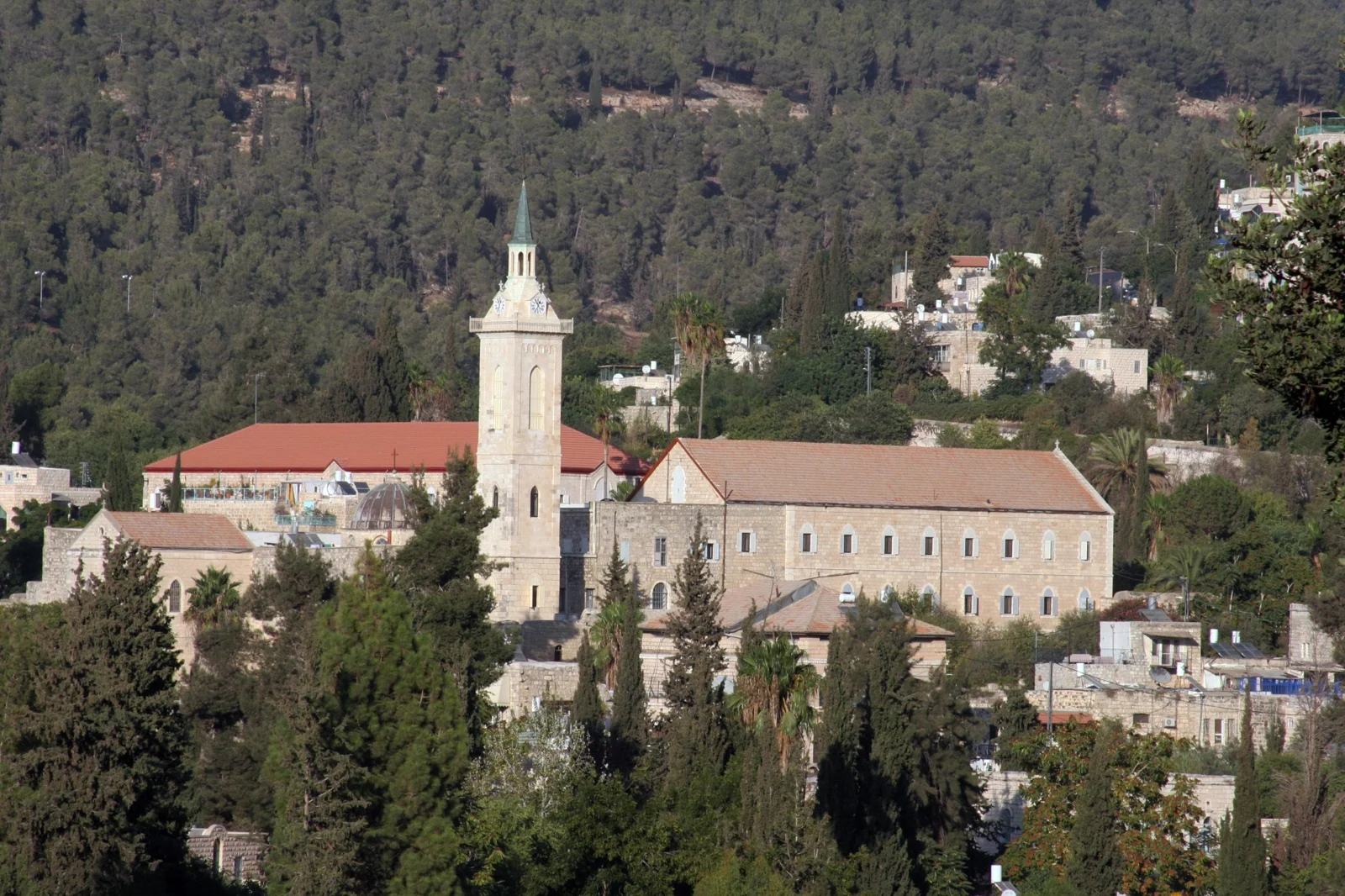
Existing birth sanctuaryThe Franciscan shrine known as Saint John in the Mountains commemorates John’s birth in Ein Karem. The Custody distinguishes it from the Visitation sanctuary and from the separate desert hermitage associated with John. This distinction prevents a common confusion between birth, family meeting, and later seclusion.
Connection to the event
Traditional household attributionThe church preserves a traditional birthplace memory, expressed through prayer and pilgrimage. Its location is an inherited identification of the household, not an address supplied in Luke. The village’s network of shrines records a history of Christian remembrance as well as the Gospel themes they celebrate.
What this does not establish
The passage’s final reference to John growing and living in the deserts does not identify a particular cave. The birth shrine cannot prove the circumstances of the naming or Zechariah’s restored speech. Those belong to Luke’s narrative and should not be presented as conclusions derived from the building.
Questions to explore
- Read the naming scene before the Benedictus, so the father’s song grows from the family’s shared decision rather than floating free of its context.
- Compare the birth shrine’s purpose with the Visitation church; both involve Elizabeth, but they commemorate different episodes.
Plan with the place in mind
- Ask specifically for the birth sanctuary in Ein Karem when arranging a guide; do not substitute the desert hermitage without explaining the change.
- Confirm current opening and service arrangements, and check the actual approach and interior levels if stairs are a concern.
- A combined village visit works best with separate time for each reading, a rest stop, and attention to local traffic on narrow streets.
Opening hours and prices are not live. Before traveling, confirm access, services and local conditions with the site operator and relevant authorities.
No precise location
The shrine is a traditional birthplace; Luke does not provide a precise town or household coordinate.
Take something with you
Whose voice in your family is usually treated as secondary? Take ten minutes to listen without correcting their account. Elizabeth’s clear naming of the child offers a useful challenge to automatic assumptions about who gets to decide.
Continue in prayer · For ThisSources & further reading
Sources explain the passage, the tradition or the present site; they do not all support the same kind of claim.
- Luke 1:57–80 · full biblical text
- Custody of the Holy Land · John the Baptist in Ein Karem
- World English Bible · Full chapter
Guide prepared: November 12, 2026. AI-assisted synthesis; no independent academic review. Our editorial approach