Read the passage
John 11:1–44
Read the passage within its full chapter, not as an isolated line.
Read the chapter · World English BibleJesus wept.
John introduces Lazarus through his sisters and through Jesus’ affection for their household. Yet the journey is delayed, and returning to Judea involves danger. Martha and Mary each bring Jesus the painful thought that things might have been different if he had arrived earlier. Their words are not edited out of the story. Martha’s conversation concerns resurrection; Mary’s encounter is surrounded by mourning. Jesus weeps before calling Lazarus out. Read beyond verse 44 as well: the sign brings belief, but also intensifies the conflict that leads towards Jesus’ death. This is not an uncomplicated happy ending attached to a formula for obtaining miracles. It is a narrative about friendship, loss, belief and the cost of returning to a dangerous place.
What we know — and what remains open
Identification of the place
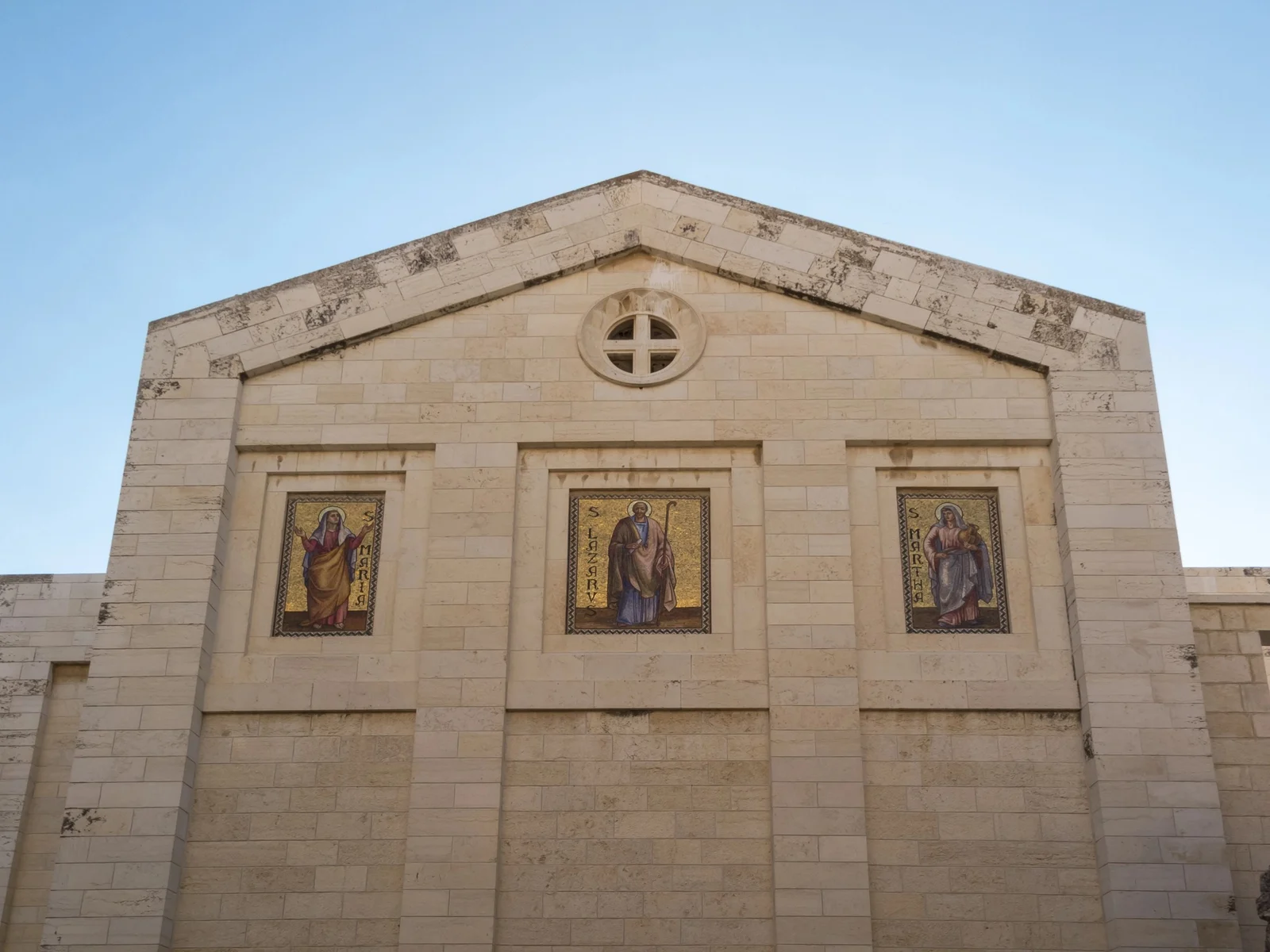
Bethany identified; ancient burial settingThe village is identified with al-Eizariya, east of Jerusalem. The Franciscan sanctuary and the traditionally identified tomb are separate nearby stops. Archaeological work has documented earlier churches and a burial landscape. The tomb has been altered over time; its present approach is not an untouched first-century entrance. The map marks the tomb, not an accessible entrance to every part of the complex.
Connection to the event
Tomb venerated since late antiquityFourth-century pilgrims already described a place of remembrance associated with Lazarus. The sanctuary therefore preserves a long history of Christian devotion rather than a recently invented association. Its architectural layers tell the story of communities returning to John’s account across centuries. That continuity is historically meaningful even when it cannot identify the occupant of a particular burial chamber with certainty.
What this does not establish
A venerable tomb tradition is not archaeological verification of a resurrection. Nor does John’s account promise that bereaved people will receive the same outcome if they believe strongly enough. Jesus’ tears give no basis for treating grief as spiritual failure. Keep the distinction between the Gospel’s claim, the site’s history and a personal application.
What to notice when you visit
- At the sanctuary, compare the visible remains of earlier churches with the modern worship space. Ask which architectural period you are looking at.
- If you enter the tomb, notice the descent and the confined chamber rather than trying to reconstruct every movement in John’s account from the present layout.
- Read Martha’s and Mary’s exchanges separately. Their shared opening words lead into different encounters; the story allows more than one way of bringing sorrow to Jesus.
Plan with the place in mind
- Confirm the road approach with a local operator. The separation barrier affects the journey from Jerusalem; a short straight-line distance does not describe the actual route.
- The tomb involves a steep stair descent and a small lower chamber. Ask about current physical access before committing; plan a sanctuary-level reading for anyone unable to descend.
- Confirm the sanctuary and tomb arrangements separately. Leave time for a quiet pause and for the people who live and worship here, rather than treating the village as a quick photo stop.
Opening hours and prices are not live. Before traveling, confirm access, services and local conditions with the site operator and relevant authorities.
Approximate visitor landmark; not a boundary or proof of the historical event. Open map
Take something with you
Who needs your company more than your explanation? Send a simple message offering a specific act of support. Let the person choose whether to talk; companionship does not require solving their grief.
Continue in prayer · For ThisSources & further reading
Sources explain the passage, the tradition or the present site; they do not all support the same kind of claim.
- John 11:1–44 · full biblical text
- Custody of the Holy Land · Bethany sanctuary
- Pro Terra Sancta · Tomb history and physical access
- OpenStreetMap-derived visitor landmark · Lazarus tomb
Guide prepared: November 12, 2026. AI-assisted synthesis; no independent academic review. Our editorial approach