Read the passage
Acts 28:16–31
Read the passage within its full chapter, not as an isolated line.
Read the chapter · World English BibleAfter arrival, Paul calls together local Jewish leaders and explains why he has come as a prisoner. Further conversation turns to his understanding of Jesus through the law and the prophets. The listeners respond differently; the account does not describe every Jewish person in Rome rejecting him. The final verses show an extended period of receiving visitors and proclaiming the kingdom of God with freedom of speech despite personal constraint. The ending leaves important questions unanswered: it does not narrate the result of the appeal, a final trial or Paul's death. That openness is part of the reading, not a gap to fill by silently importing every later tradition. The distinctive question is what an open door can mean when circumstances are limited. Paul's setting is neither unrestricted travel nor total isolation; the story invites attention to forms of welcome and communication possible inside real constraints.
What we know — and what remains open
Identification of the place
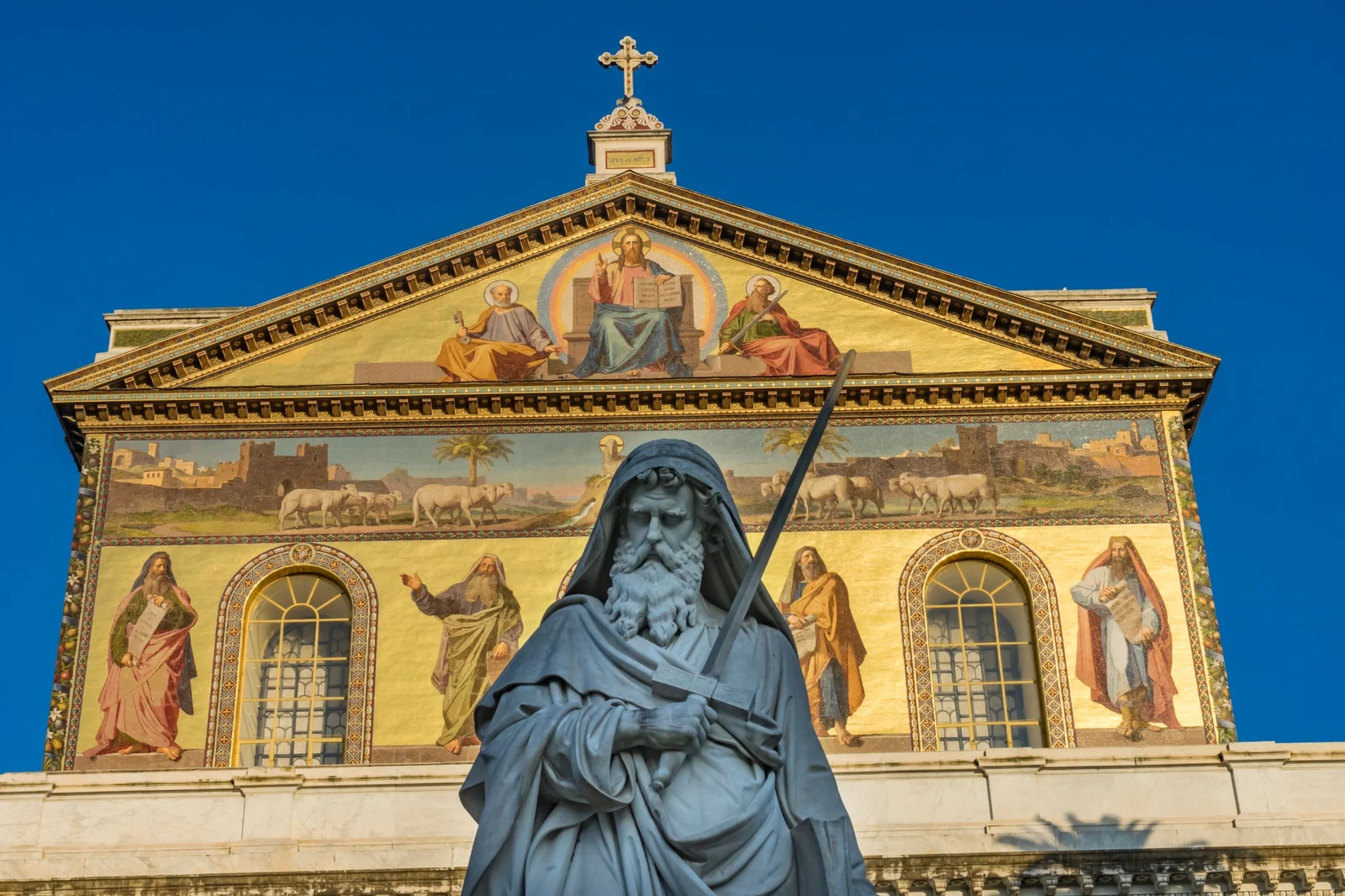
Rome named; lodging unidentifiedThe basilica's own archaeological account describes the sarcophagus below the papal altar, an inscribed memorial slab and earlier church foundations. These are concrete evidence for the history of Paul's burial commemoration in Rome. They should not be described as archaeological identification of the rented lodging mentioned in Acts 28.
Connection to the event
Ancient burial commemoration at basilicaSaint Paul Outside the Walls is the principal visitor destination for the apostle's burial tradition. Its present appearance also reflects reconstruction after the nineteenth-century fire. Other Roman places preserve imprisonment traditions, but those should be introduced separately; the Mamertine Prison must not be substituted for the guarded lodging described at the end of Acts.
What this does not establish
The basilica's inscription and sarcophagus demonstrate a significant memorial tradition, not a modern laboratory identification asserted by this guide. Acts itself does not give the address of Paul's house or describe his martyrdom. A responsible itinerary keeps biblical narrative, early commemoration and later legends distinguishable.
Questions to explore
- At the basilica, read the official explanation of the tomb area before praying there; distinguish the ancient memorial evidence from the later church surrounding it.
- Read the last paragraph of Acts in a quiet place, noticing that its final image is continuing welcome and teaching rather than a narrated execution.
Plan with the place in mind
- Plan the basilica as a separate journey from central Rome's ancient forum area. Its name Outside the Walls is useful geographical orientation, not a small detour label.
- Check the basilica's official visitor and worship arrangements, including which archaeological or adjoining areas require separate access.
- For a group, agree a meeting point outside prayer areas and leave room for individual reflection rather than treating the tomb as a compulsory photo stop.
Opening hours and prices are not live. Before traveling, confirm access, services and local conditions with the site operator and relevant authorities.
No precise location
The rented home is unidentified. The basilica is a separate burial memorial, not a mapped substitute for Paul's lodging.
Take something with you
Identify one limitation you cannot immediately change. Within it, what genuine form of welcome remains possible without denying the difficulty or pretending that confinement is freedom?
Continue in prayer · For ThisSources & further reading
Sources explain the passage, the tradition or the present site; they do not all support the same kind of claim.
- Acts 28:16–31 · full biblical text
- Saint Paul Outside the Walls · Tomb archaeology
- Saint Paul Outside the Walls · History
Guide prepared: November 12, 2026. AI-assisted synthesis; no independent academic review. Our editorial approach