Read the passage
Luke 23:26–31
Read the passage within its full chapter, not as an isolated line.
Read the chapter · World English BibleSimon comes from the countryside when those escorting Jesus seize him and place the cross on him. Luke describes him carrying it behind Jesus, an image that resonates with the Gospel’s earlier language about discipleship. Yet the text says he was compelled; it does not tell us his feelings or give permission to invent an enthusiastic volunteer. A crowd follows, including women lamenting Jesus. His response turns attention toward their children and the suffering ahead. This is prophetic warning within the Passion, not a dismissal of women’s compassion. The image of green and dry wood intensifies the question of what awaits the city. Read these verses before the crucifixion to see that the condemned man is still addressing other people’s future. Ask who becomes visible when we look away from the central figure: a passerby forced into service and women whose grief is taken seriously enough to receive an answer.
What we know — and what remains open
Identification of the place
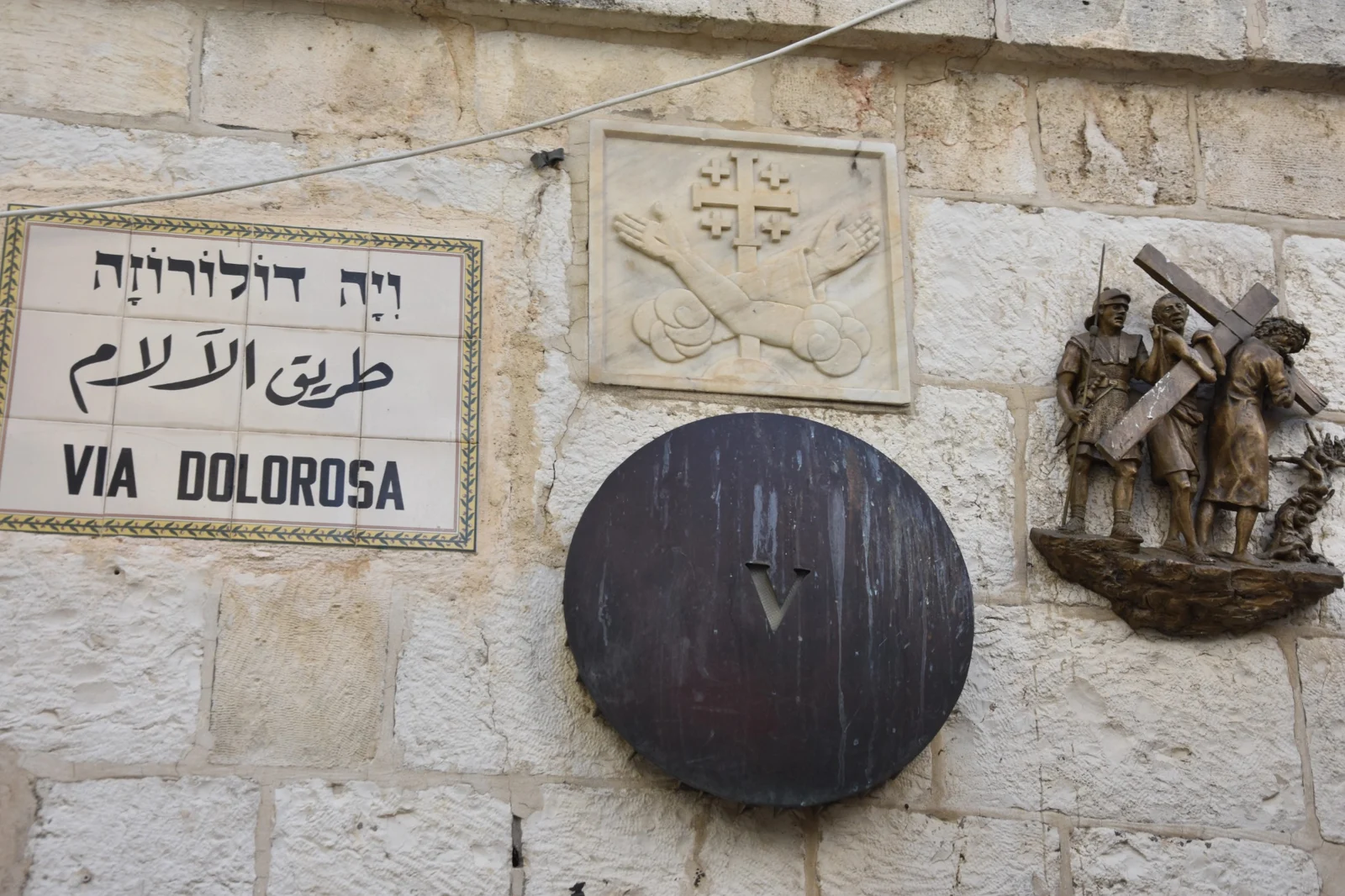
Stations identified; encounter points unknownThe fifth and eighth stations are identifiable commemorative locations in the Old City. The Franciscan Terra Sancta Museum explains their narrative associations and the development of the route. These markers are evidence for pilgrimage practice, not a first-century street survey recording where Simon or the women stood.
Connection to the event
Developed pilgrimage routeWalking the stations places bodily movement alongside prayer: stopping, carrying, accompanying, and continuing. The route has changed across Christian history. Treat that history as part of the visit rather than a defect to conceal. A remembered encounter can be spiritually important without an exact archaeological address.
What this does not establish
Luke does not name a street, supply a complete procession itinerary, or record the women’s identities. Do not turn the warning into a prediction against all Jewish people or suggest that later civilian suffering was deserved. The passage belongs to a Jewish setting and includes compassion within a violent execution.
Questions to explore
- At Station V, read the single verse about Simon slowly and distinguish what Luke states from details added by art.
- At Station VIII, notice how a short halt within a busy neighborhood can hold a reading about grief without treating residents as scenery.
Plan with the place in mind
- Use a current station map and confirm local access before beginning; lanes, steps, crowds, and worship can affect the pace.
- Keep a group to one side of passages and leave room for residents and deliveries. Read longer commentary at a quieter stopping point.
Opening hours and prices are not live. Before traveling, confirm access, services and local conditions with the site operator and relevant authorities.
No precise location
No exact event location is established; the named visitor site is a contextual or traditional landmark, not a verified event pin.
Take something with you
Whose burden have you noticed but not helped carry? Offer one bounded, practical act of support today. Respect the other person’s wishes; carrying a burden does not mean taking control of someone else’s life.
Continue in prayer · For ThisSources & further reading
Sources explain the passage, the tradition or the present site; they do not all support the same kind of claim.
- Luke 23:26–31 · full biblical text
- Terra Sancta Museum · fourteen stations
- Terra Sancta Museum · route origins
Guide prepared: November 12, 2026. AI-assisted synthesis; no independent academic review. Our editorial approach