Read the passage
Matthew 4:1–11
Read the passage within its full chapter, not as an isolated line.
Read the chapter · World English BibleJesus said to him, “Again, it is written, ‘You shall not test the Lord, your God.’ ”
The temptation follows Jesus’ baptism and precedes his public ministry in Galilee. Matthew moves through three tests: bread in hunger, a spectacular rescue at the temple and power obtained through misdirected worship. Jesus answers with Scripture, but the tempter also quotes Scripture. That detail matters: a biblical quotation does not automatically make an argument faithful to its context. The refusals turn attention from what Jesus could gain towards the relationship he will not distort. Read the chapter’s cross-references to Deuteronomy as well as the individual sayings. The account is about Jesus’ identity and obedience; it is not an instruction to repeat his forty-day fast or to create danger in order to demonstrate personal faith.
What we know — and what remains open
Identification of the place
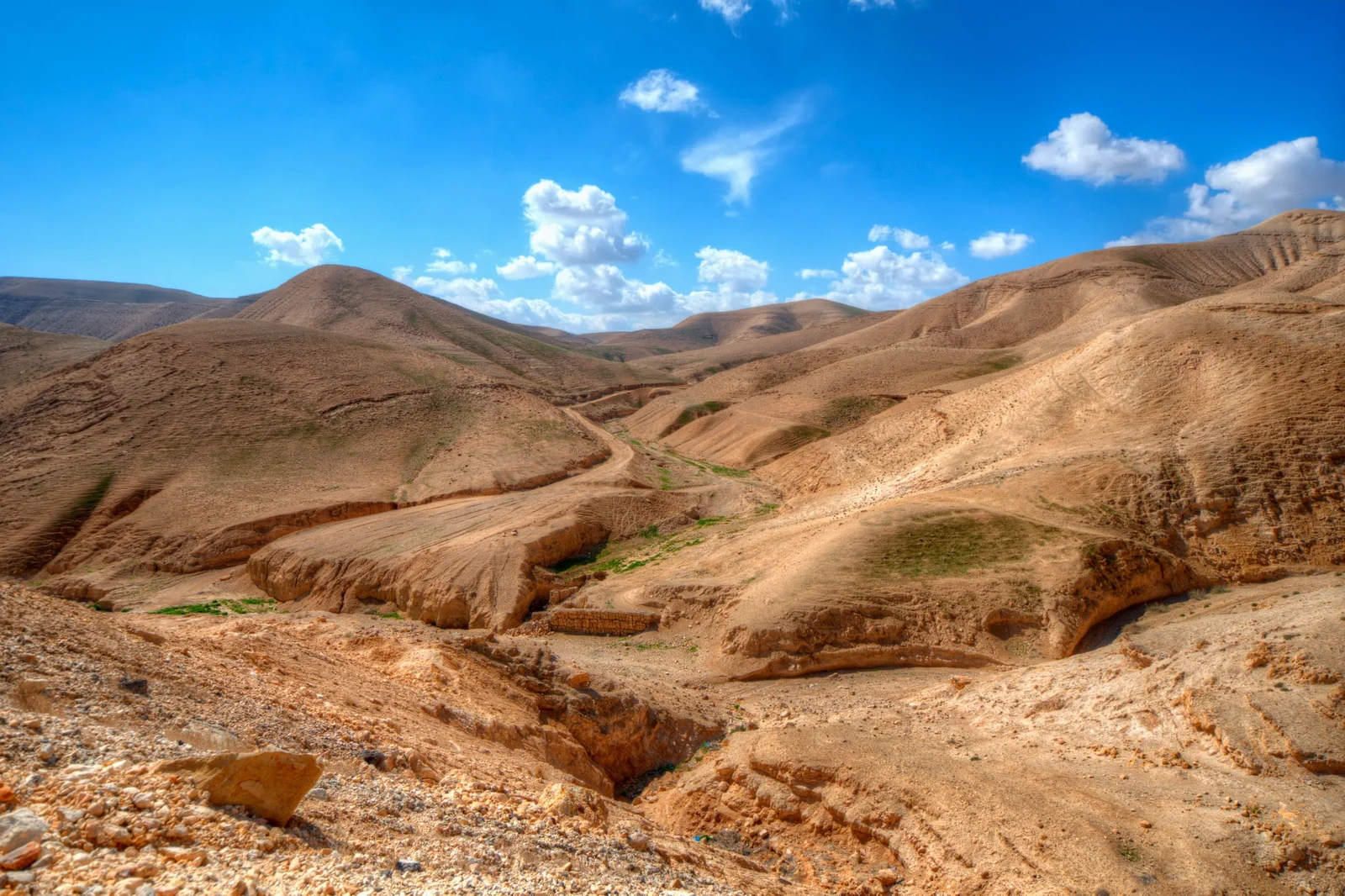
Identifiable monastery and mountain landscapeDeir Quruntal is a Greek Orthodox monastery on the cliffs northwest of Jericho. Its visitor setting combines rock, caves, worship spaces and views across the valley. These are observable features of the present sanctuary. Matthew names the wilderness, the holy city and a high mountain, but supplies no coordinates that uniquely identify this cliff.
Connection to the event
Traditional wilderness locationChristian tradition connects the mountain and its cave sanctuary with the forty days of fasting and temptation. Monastic life and later rebuilding have given that remembrance a physical form. The stone shown within the sanctuary belongs to this devotional tradition. Describing it as a traditional place of prayer respects its meaning without presenting the building or stone as independent evidence for every scene in the Gospel.
What this does not establish
A compelling landscape is not a geographical demonstration. The monastery does not establish that all three temptations happened at one spot; Matthew itself changes settings. Nor should the account be used to suggest that hunger, exhaustion or intrusive thoughts reveal a failure of faith. Its challenge to testing God is especially relevant when turning a pilgrimage into an endurance contest.
What to notice when you visit
- From a permitted viewpoint, notice the contrast between Jericho’s settled valley and the exposed rock. Let it prompt reflection on dependence without claiming that scenery proves the story.
- Inside the monastery, follow the distinction between ordinary visitor areas and spaces reserved for worship. Ask permission before approaching or photographing devotional objects.
- Read each temptation alongside its response. Pay particular attention to the quotation used to encourage a dangerous leap: context changes how a verse should be applied.
Plan with the place in mind
- Confirm monastery admission and cable-car operation separately before travel. Reaching an upper station is not the same as confirming access to the sanctuary.
- Ask about the remaining path, stair sections and handrails. A cable car should not be treated as a guarantee of step-free access; agree on a lower-level alternative if necessary.
- For any walking approach, obtain current local route advice, carry water and avoid making the climb a test of faith or fitness. Respect closures and remain on permitted paths.
Opening hours and prices are not live. Before traveling, confirm access, services and local conditions with the site operator and relevant authorities.
Approximate visitor landmark; not a boundary or proof of the historical event. Open map
Take something with you
Name one shortcut that promises success at the cost of something you value. Write down what you would be protecting by refusing it, and identify one practical boundary you can keep today.
Continue in prayer · For ThisSources & further reading
Sources explain the passage, the tradition or the present site; they do not all support the same kind of claim.
- Matthew 4:1–11 · full biblical text
- Travel Palestine · Deir Quruntal sanctuary and access
- Higher Presidential Committee of Churches Affairs · Monastery of the Temptation
- OpenStreetMap-derived visitor landmark · Deir al-Quruntal
Guide prepared: November 12, 2026. AI-assisted synthesis; no independent academic review. Our editorial approach