Read the passage
John 5:1–18
Read the passage within its full chapter, not as an isolated line.
Read the chapter · World English BibleJesus said to him, “Arise, take up your mat, and walk.”
Jesus arrives in Jerusalem for a feast and encounters a man who has been ill for thirty-eight years. The man’s answer to the question about being made well is striking: he describes having no one to help him reach the water. Jesus does not carry him into the pool; the command to rise changes the direction of the scene. The account then turns to the Sabbath and the authority behind the healing. Keep reading beyond the happy ending in verse 9: the carried mat becomes the subject of an argument, and the healed man initially cannot name the person who helped him. The narrative is not a formula in which sufficient optimism earns recovery. Its attention to isolation also invites a practical question: who is still waiting because nobody has offered assistance?
What we know — and what remains open
Identification of the place
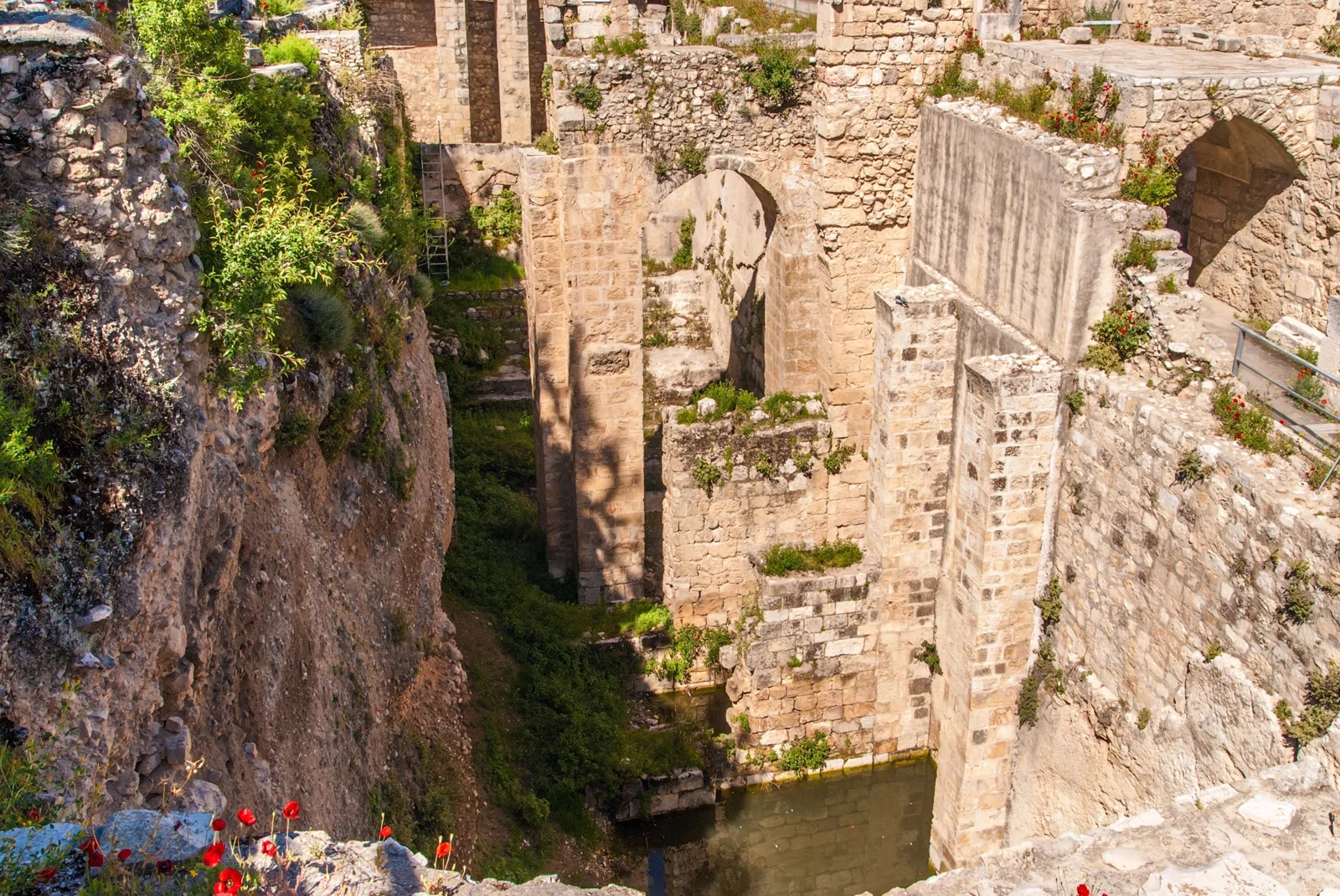
Excavated pool complexThe excavated pool complex beside Saint Anne’s is associated with the Bethesda named in John. Its paired basins and separating structure help explain the unusual description of five porticoes. The site contains several building phases; not every wall visible from the path belongs to the Gospel period.
Connection to the event
Gospel association and later commemorationLater churches commemorated the healing here. Saint Anne’s adjoining Crusader church preserves a different tradition, associated with Mary’s family. These memories share a visitor compound but should not be merged into a single biblical claim. The architectural layers record how later generations worshipped at the site.
What this does not establish
An excavated pool can illuminate John’s geographical description; it cannot independently demonstrate a miraculous cure or locate the man’s mat. Nor should the question Jesus asks become a judgment on people living with illness or disability. Some Bible editions handle the explanation about an angel stirring the water differently; the linked World English Bible includes a manuscript note, worth reading before building an interpretation around that detail.
What to notice when you visit
- Start with the site plan rather than trying to identify every exposed stone. Locate the two basins, then distinguish the later structures above them.
- Read the man’s reply before taking photographs. Let the phrase about having no helper direct your attention toward people who need assistance today.
- Visit Saint Anne’s separately as a living church. Leave room for worshippers and ask before singing or arranging group readings.
Plan with the place in mind
- Use Saint Anne’s compound on Lions’ Gate Street as your arrival landmark. Confirm entry arrangements with the Missionaries of Africa rather than assuming that every Old City church has the same schedule.
- Ask specifically which excavation viewpoints can be reached without stairs. Access to the church and access into the archaeological remains are separate questions.
- Allow an unhurried pause between the ruins and church. For an organized prayer session, contact the community in advance; do not block the narrow visitor paths.
Opening hours and prices are not live. Before traveling, confirm access, services and local conditions with the site operator and relevant authorities.
Approximate visitor landmark; not a boundary or proof of the historical event. Open map
Take something with you
Name one person who may need practical help rather than another encouraging slogan. Before the day ends, offer something specific: a lift, an errand, or time to listen without rushing their answer.
Continue in prayer · For ThisSources & further reading
Sources explain the passage, the tradition or the present site; they do not all support the same kind of claim.
- John 5:1–18 · full biblical text
- Saint Anne’s · Bethesda archaeology and commemoration
- Saint Anne’s · visitor information and community
- OpenBible · Bethesda location record
Guide prepared: November 12, 2026. AI-assisted synthesis; no independent academic review. Our editorial approach