Read the passage
John 9:1–41
Read the passage within its full chapter, not as an isolated line.
Read the chapter · World English BibleHe therefore answered, “I don’t know if he is a sinner. One thing I do know: that though I was blind, now I see.”
When the disciples see a man blind from birth, they ask whether his condition results from his own sin or his parents’ sin. Jesus rejects that proposed explanation. He makes mud, puts it on the man’s eyes and sends him to wash at Siloam; John pauses to explain the name as “Sent.” Yet the washing occupies only a small part of the chapter. Neighbors question his identity, his parents are questioned, and the man must speak repeatedly about what happened to him. Read through the final encounter with Jesus, not only the journey to the pool. A useful thread is the contrast between confident claims to know and the man’s steadily developing understanding. This is not an invitation to treat blindness as a personal failing. The opening exchange challenges precisely the impulse to turn someone’s suffering into an accusation.
What we know — and what remains open
Identification of the place
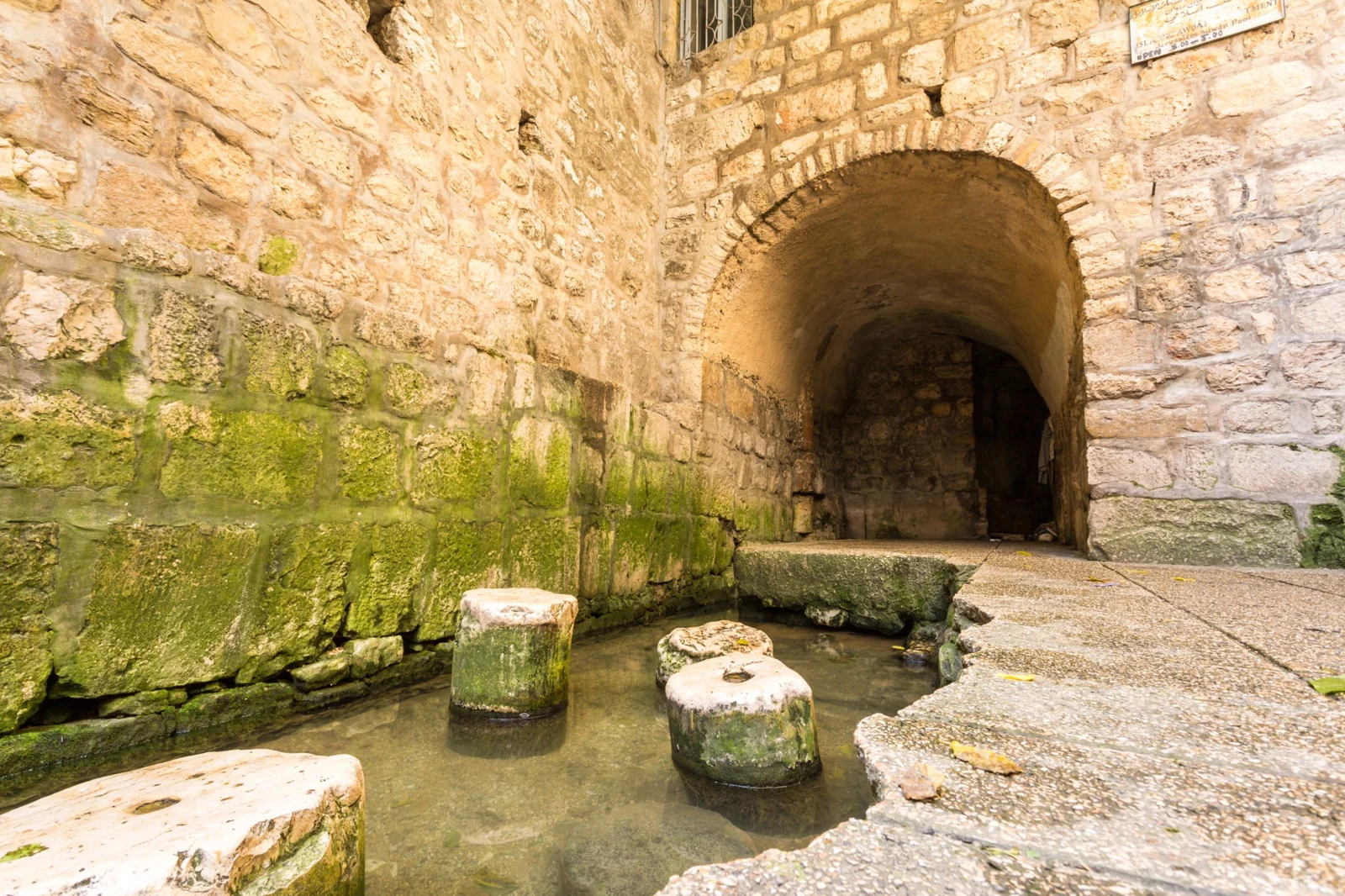
Excavated Second Temple poolThe stepped pool in the southern City of David area is an excavated feature of Jerusalem’s ancient water landscape. Steps were exposed during modern infrastructure work in 2004, followed by archaeological investigation. The operator distinguishes its Second Temple development from the older water system associated with the Gihon spring.
Connection to the event
Named pool in John’s accountJohn names Siloam as the place where the man washes, not necessarily the place where Jesus first meets him. The pool’s identification therefore helps place one movement within the story. Christian visitors connect these remains with that reading, while the archaeological site also belongs to the broader history of Jerusalem’s water supply and pilgrimage.
What this does not establish
The remains do not prove the healing or preserve a traceable route followed by the man. A visit to the water system is not a reenactment with guaranteed spiritual or physical results. Do not confuse the excavated Second Temple pool with every later basin carrying the Siloam name, or assume that a tunnel tour is required to understand John’s account.
What to notice when you visit
- Look at the descending steps and imagine the repeated practical movements of people approaching water. Keep that ordinary urban setting alongside the Gospel reading.
- Compare the pool’s displayed phases with any plan of the older tunnel and spring. Different structures may be connected without belonging to the same date.
- Read verses 8–12 aloud in your group. Notice how quickly other people discuss the man and how important it is that he answers for himself.
Plan with the place in mind
- Confirm the pool’s currently accessible viewing areas with the City of David visitor service. Excavation announcements describe projects; they are not a guarantee that every section is open on your visit date.
- Specify whether you want the pool, a dry archaeological route or a water-tunnel route. Ask about stairs, narrow passages and the return journey before booking, especially when mobility is limited.
- Plan arrival and departure in the Silwan neighborhood carefully and respect its residents. Do not treat a map pin as an instruction to enter excavation areas or follow an unofficial shortcut.
Opening hours and prices are not live. Before traveling, confirm access, services and local conditions with the site operator and relevant authorities.
Approximate visitor landmark; not a boundary or proof of the historical event. Open map
Take something with you
Think of a situation where you have explained someone else’s life without hearing them. Replace one assumption with one respectful question, then make space for an answer you did not expect.
Continue in prayer · For ThisSources & further reading
Sources explain the passage, the tradition or the present site; they do not all support the same kind of claim.
- John 9:1–41 · full biblical text
- City of David · Siloam excavation background
- City of David · visitor questions
- OpenBible · Siloam location record
Guide prepared: November 12, 2026. AI-assisted synthesis; no independent academic review. Our editorial approach